

Ontario Power Generation (OPG) has acknowledged that “DNNP Unit 1 is no longer expected to achieve the previously disclosed commercial operation date target of October 2030 or be completed within the previously disclosed estimated cost of $7.7 billion.”
OPG explicitly identifies unfinished engineering by GE Vernova Hitachi as the primary contributing factor going on to say…
“This reflects GE Vernova Hitachi (GEVH) Nuclear Energy’s ongoing engineering for its first-of-a-kind SMR, which has impacts on construction execution and supply chain performance.”
OPG has not yet provided updated cost or schedule estimates indicating the extent of the anticipated budget increase or delay. According to CEO Nicolle Butcher, the assessment informing these revised estimates is expected to be substantially complete by mid-2027.
What can be inferred is that detailed engineering is falling behind construction, causing costly delays, rework, and lost productivity. These pressures are compounded by the departure of several senior engineers at a critical stage of the project, when GVH’s already stretched engineering resources are needed most.
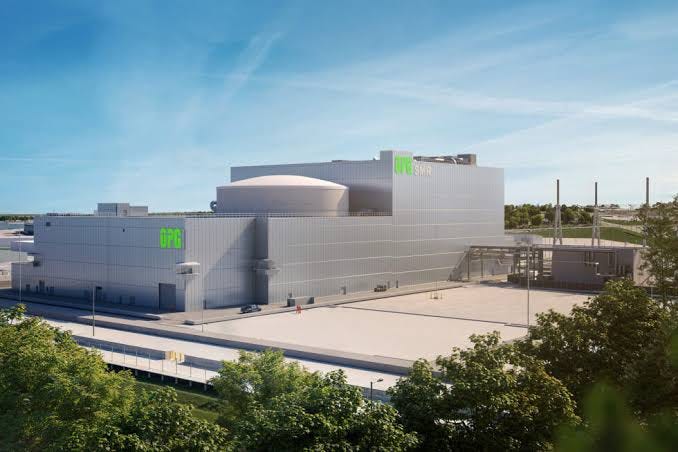
Meanwhile, GVH is pursuing an expanding portfolio of projects, including Clinch River in Tennessee, where TVA aims to begin construction with a design more than 95 percent complete and benefit directly from lessons learned at Darlington. Ontario is thus absorbing the risks of pioneering the first BWRX-300 while the vendor prepares to deliver its successors.
The admission exposes a troubling Canadian vulnerability. Having committed billions to pioneering an American reactor design, Ontario now depends on a foreign vendor whose scarce engineering resources are being pulled in competing directions.
The question is whether Queen’s Park and Ottawa can use the considerable financial and commercial leverage at their disposal to demand that GE Hitachi prioritize the engineering resources needed to get Darlington back on track, and whether Ontario will repeat this mistake as it weighs another American reactor design, the AP1000, for its next generation of large nuclear plants.
The Engineering Challenge Behind Darlington’s Delays
The BWRX-300 was sold on the promise of simplicity. At 300 megawatts, its smaller output, passive safety systems and simplified configuration were supposed to avoid the complexity that has plagued large Western nuclear construction projects.
For decades, the nuclear industry developed progressively larger reactors from proven designs. Scaling down was expected to be easier, but the BWRX-300 may be challenging that assumption. The physics of boiling water, coolant circulation and heat transfer do not scale neatly with reactor dimensions. Although the BWRX-300 draws on decades of GE boiling water reactor experience, its integrated design is new. Translating it into thousands of coordinated engineering specifications, fabrication drawings and installation instructions is proving an enormous undertaking.
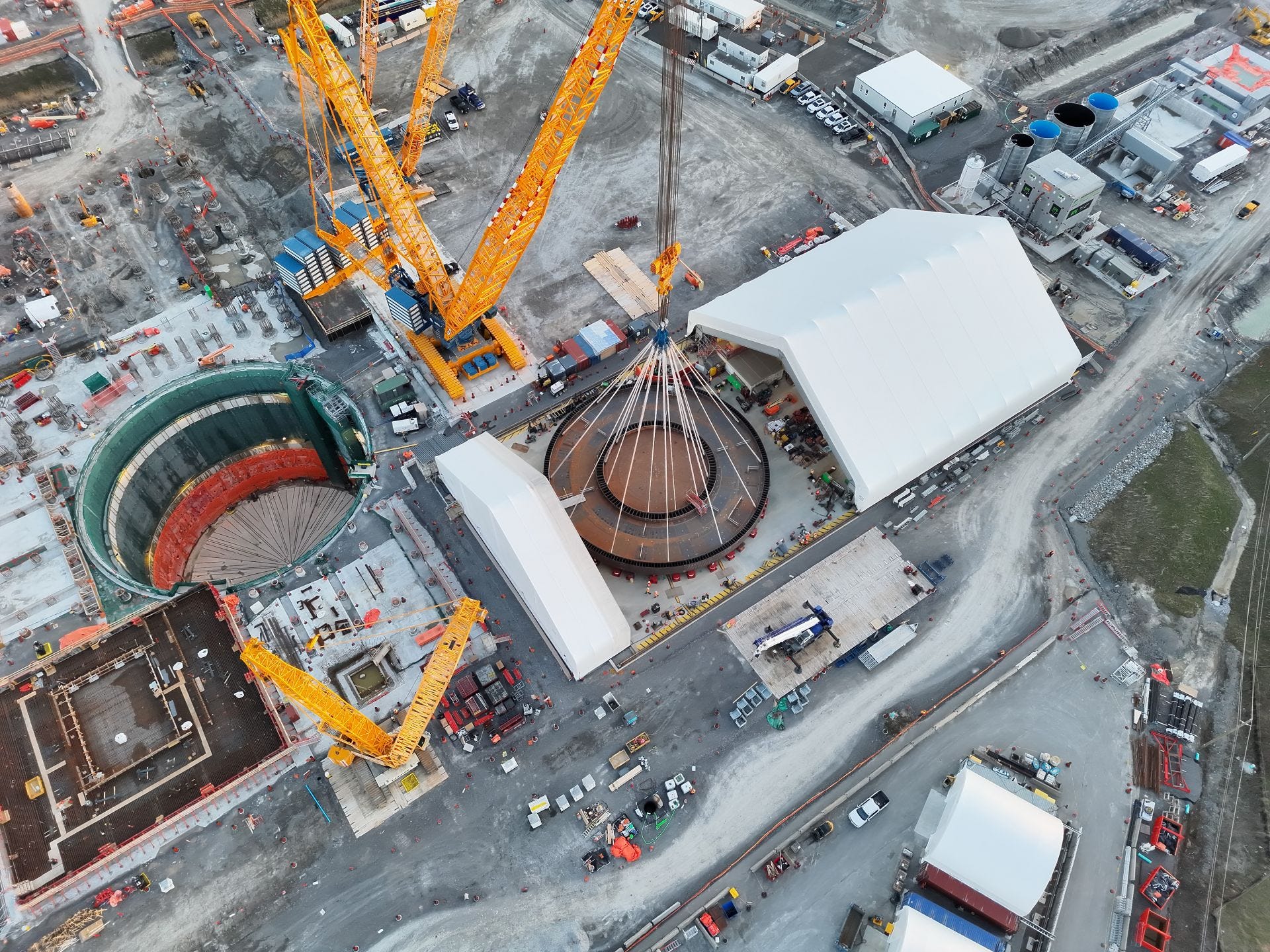
Construction becomes especially unforgiving when engineering falls behind. A late change to a seismic calculation can require modifications to structural supports, piping routes and equipment layouts. Engineers must revisit interconnected analyses while construction teams decide whether to proceed at the risk of expensive rework or stand idle awaiting finalized designs.
Experienced engineers are particularly valuable at this stage. Their familiarity with the design’s evolution, regulatory commitments, and complex interfaces cannot be readily replaced by adding inexperienced personnel. Yet GVH has been losing precisely this sort of expertise.
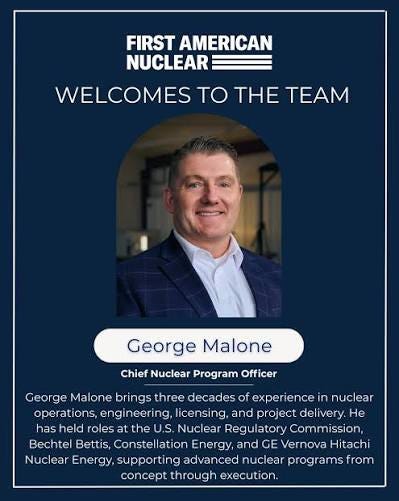
George Malone, formerly a project director on the BWRX-300 program, joined First American Nuclear Company (FANCO), a startup developing a lead-bismuth-cooled fast reactor, in April. In October, Hadron Energy, a startup developing a 10-megawatt microreactor, announced it had recruited Kent Olson, previously GVH’s reactor design engineering manager.
The irony is difficult to ignore. As GVH struggles with the hard, unglamorous engineering of building an actual nuclear reactor, some of its most experienced personnel are being lured away by startups whose fanciful designs remain firmly in the realm of Rickover’s paper reactors, blissfully unburdened by the realities of nuclear construction they will almost certainly never live to confront.
These departures alone cannot explain Darlington’s difficulties. But they illustrate the competition for experienced nuclear engineers at a moment when GVH needs to expand its capacity to support construction.
Who Gets the Engineers?
In September, the US Nuclear Regulatory Commission issued a construction permit for the Tennessee Valley Authority’s proposed BWRX-300 at Clinch River, Tennessee. GVH is working alongside Bechtel and Sargent & Lundy on the project’s design and development.
Darlington is already under construction, at a critical stage when engineering delays translate directly into rising costs, disrupted schedules and lost productivity as skilled tradespeople wait for finalized designs. Clinch River, meanwhile, has yet to receive a final investment decision. Nevertheless, the American project creates competing demands on GVH’s stretched engineering resources at precisely the moment its Canadian customer can least afford delays.
And Clinch River may be only the beginning.
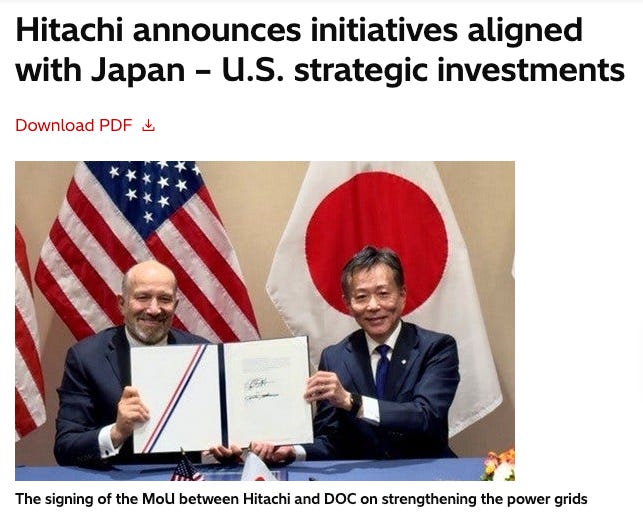
In October 2025, Washington and Tokyo identified up to US $100 billion in potential BWRX-300 projects under their bilateral investment framework. In March, the two governments advanced plans for up to US $40 billion in Japanese-backed investment to deploy approximately ten BWRX-300 reactors in Tennessee and Alabama. GE Vernova and Hitachi are also exploring deployment in Japan and Southeast Asia, while prospective customers in Poland and elsewhere advance their programmes.
These opportunities vary greatly in maturity, but they point toward a rapidly expanding commercial workload for an engineering organization already under considerable strain.
Washington is treating nuclear construction as a strategic industrial priority, backed by enormous public resources. Canadian decision-makers face the uncomfortable reality that GE Hitachi may not consistently prioritize Darlington when its American customers are backed by the full weight of US industrial policy.
The Cost ot Canada of Pioneering a Foreign Reactor Design
What makes this situation particularly galling is the generosity of Canada’s commitment to GVH’s technology. OPG’s four-reactor BWRX-300 programme was budgeted at $20.9 billion, including $7.7 billion for the first unit and shared infrastructure.
With OPG now acknowledging that Unit 1 will exceed that estimate, Canada’s financial exposure is growing. The publicly owned utility is backed by Ontario’s government and, ultimately, its electricity ratepayers.
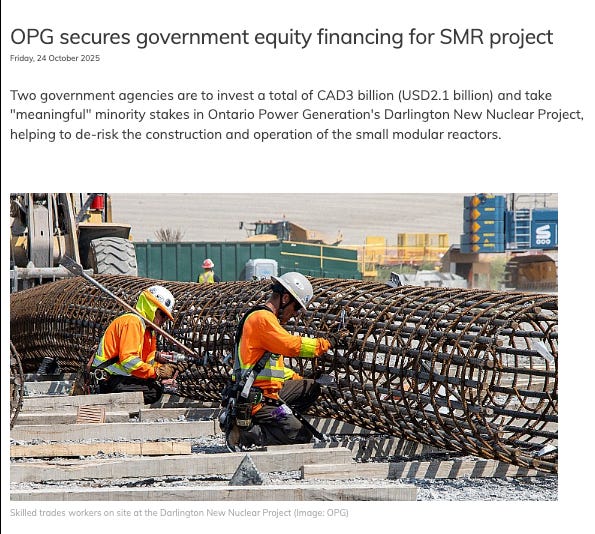
Ottawa has committed up to $2 billion through the Canada Growth Fund, while Ontario’s Building Ontario Fund has committed another $1 billion in equity. The Canada Infrastructure Bank has provided $970 million in low-interest financing. Eligible expenditures can also benefit from the federal 15 percent Clean Electricity Investment Tax Credit.
These financing arrangements dramatically reduce the burden of securing commercial capital for an unproven reactor design. Compare this with the enormous financing costs confronting privately financed nuclear projects such as Britain’s Hinkley Point C. Canada is deploying the full weight of its public balance sheets to overcome one of the greatest obstacles to new nuclear construction: the cost of capital and the financial risks of building first. Yet rather than directing that extraordinary industrial policy support toward strengthening Canadian-owned CANDU technology, we have used it to help establish an American competitor.
If the BWRX-300 succeeds, GVH will have a commercially demonstrated reactor to market globally. Canadian suppliers may secure export contracts, and OPG could benefit from deployment expertise. But the core intellectual property and international reactor sales franchise remain principally in the hands of the foreign vendor, while Canadian public investors and electricity customers face the consequences of rising project costs.
OPG and the Ontario government deserve credit for securing exceptionally high Canadian content in the BWRX-300 project. But achieving that localization comes at a cost, requiring domestic manufacturers to qualify components and develop capabilities for an unfamiliar American design, even as Ontario’s existing CANDU supply chain is running hot from billions in refurbishment investments.
In 2012, Candu Energy was developing detailed construction plans and cost estimates for two Enhanced CANDU 6 reactors at Darlington. Ontario shelved those plans the following year as electricity demand stagnated. But when new nuclear construction returned to the agenda, irrational exuberance for small modular reactors had transformed the procurement itself. CANDU was no longer in contention.
A new CANDU at Darlington could have leveraged that revitalized supply chain while establishing a modern reference plant to strengthen Canadian nuclear exports. Instead, Ontario committed billions to pioneering an American reactor technology, helping establish a new competitor to Canada’s own nuclear industry.
Are We About to Make the Same Mistake Again?
Ontario is considering the American AP1000 for its next generation of large nuclear reactors, competing against Canadian CANDU technology. Yet the vulnerabilities emerging at Darlington could recur if Canada finds itself competing with an ambitious American nuclear construction program for scarce engineering resources.
Westinghouse is a very different company from the one that embarked on America’s last major nuclear construction programme. Its disastrous experience at Vogtle and V.C. Summer drove the company into bankruptcy in 2017, triggering hundreds of layoffs and a restructuring program targeting 1,500 job reductions.
When Brookfield acquired Westinghouse in 2018, its investment assumptions even contemplated a future in which no new nuclear power plants would be built. As a result, further workforce reductions followed, hollowing out an organization that had once maintained substantial engineering and construction capabilities. The company was refocused on the more predictable revenues of nuclear fuel, maintenance and services, with little reason to preserve the large, specialized engineering teams required to deliver new reactors.
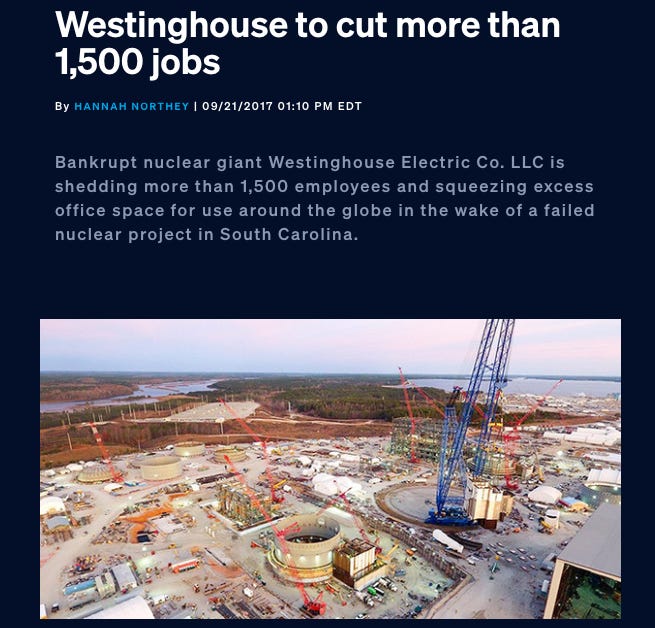
That restructuring made commercial sense when American nuclear construction had largely ground to a halt. Westinghouse now faces the challenge of rebuilding capabilities diminished over years of downsizing, just as its ambitions for new nuclear construction are expanding dramatically.
Washington has announced up to US$80 billion in support for new Westinghouse reactor projects, while Poland and other international customers advance their programmes. The company is also heavily engaged in America’s emerging nuclear uprate market, reporting involvement at various stages with 28 of approximately 30 contemplated applications as of July 2026. These power increases can require extensive engineering analysis and modifications to reactor systems, creating another potential demand on specialized personnel.
There are also unresolved questions about AP1000 design maturity. Westinghouse has updated its standard design to incorporate lessons from Vogtle, but thousands of field modifications and change orders must be reconciled with engineering calculations, three-dimensional models and fabrication drawings to produce a repeatable, construction-ready design.
How much of Vogtle’s engineering has been incorporated into that package? And does Westinghouse have the experienced personnel to adapt it for Canadian requirements while meeting its expanding American and international commitments?
These questions deserve serious scrutiny before Ontario commits billions more to a second American vendor facing competing demands from Washington’s own nuclear ambitions.
The Larger Lesson for Canada
Ontario’s immediate priority must be getting Darlington back on track. GE Hitachi needs to hear an unequivocal message from Queen’s Park and Ottawa: completing the engineering required to deliver Canada’s first BWRX-300 must take precedence over the company’s expanding international ambitions.
Canada is hardly powerless. OPG’s Integrated Project Agreement provides broad audit rights, performance-based financial incentives and contractual protections where project partners fail to meet the required standard of care. Ontario also retains substantial commercial leverage through three additional planned BWRX-300 reactors that have yet to reach final investment decision. The province should use this leverage to demand an independently verified engineering recovery plan, backed by dedicated senior personnel, binding delivery milestones and transparent reporting. Where contractual obligations have been breached, OPG should pursue the remedies available under its agreements.
The larger lesson concerns the next generation of nuclear construction. Canada has already assumed extraordinary first-of-a-kind risks to establish an American reactor design as an international commercial product. We cannot afford to repeat this arrangement with the Westinghouse AP1000, committing billions of dollars and decades of energy planning to foreign vendors whose scarce engineering resources and strategic priorities ultimately lie elsewhere.

Darlington must succeed. But the next generation of Canadian nuclear construction should be built around a technology whose design authority, engineering expertise and commercial destiny remain firmly in Canadian hands.
It is time to be Maîtres chez nous. Canada’s next reactors must be CANDU.
Like this post if you think GE Hitachi needs to get its BWRX together.
And in 2025 Tennessee’s senators meddled with TVAs board ostensibly because of doing “too much design work,” and now their Canadian partners don’t have the completed designs to continue construction, risking the clinch river project too. Ironic!
Now there is a construction license issued for X-Energy and Dow at Dow's Seadrift Station in Long Mott, TX for the Xe-100, an HTGR with a novel design and no previous construction experience.
This should be interesting as well as the BWRX 300.
I wish everyone the best of luck.
I lived through VC Summer.....that was a scary time.