

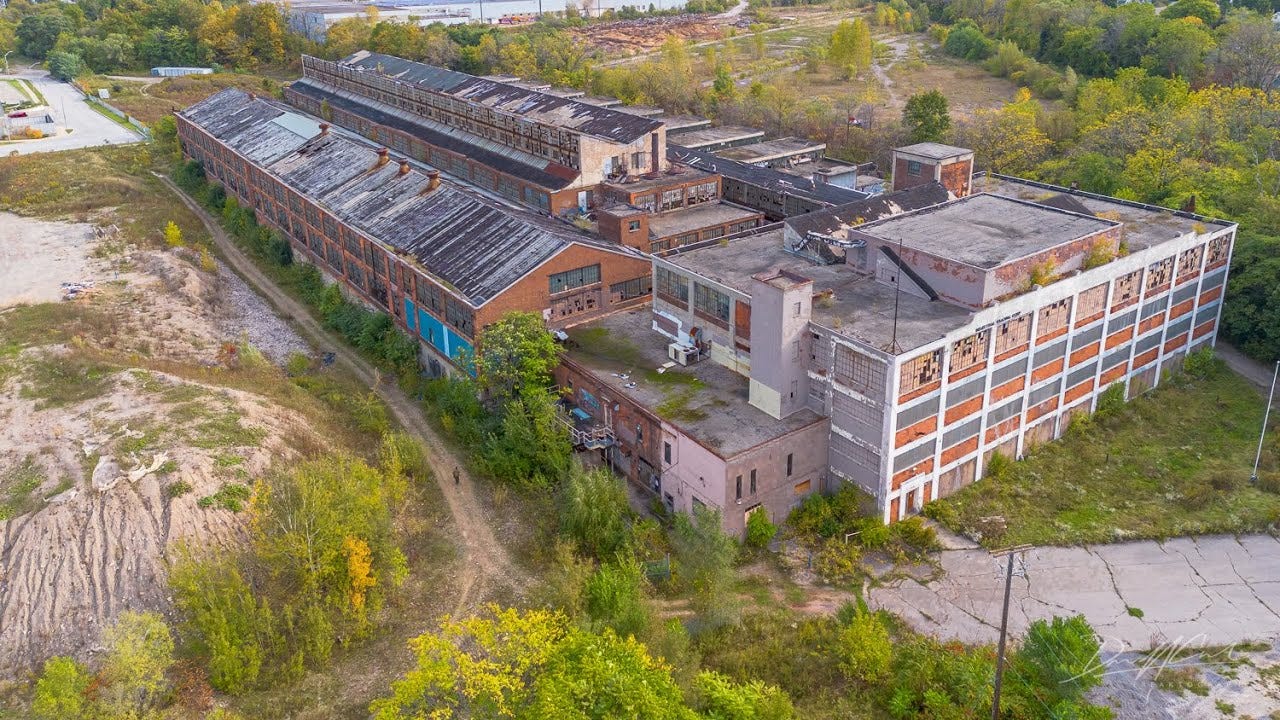
Westinghouse Electric Company has confidentially filed for an IPO. The nuclear business which was severed from its industrial parent the Westinghouse Electric Corporation nearly three decades after its transformation into CBS will have a tricky pitch to public markets.
That story will rest heavily on the promise of a nuclear revival, and on its ability to deliver some of the world’s most complex industrial projects on reasonable timelines and at reasonable cost.
That challenge, however, is unfolding in the context of the decades long deindustrialization of the United States, characterized in particular by the erosion of its manufacturing and construction capacity on which projects like nuclear power plants depend.
Few companies illustrate the economic transformation of the United States from industrial powerhouse to a service and finance dominated economy more vividly than the 111 year history of the Westinghouse Electric Corporation.
To understand the predicament facing the nuclear company that carries George Westinghouse’s name today, it is worth following what happened to the industrial empire from which it was cut loose.
From Industrial Giant to a Media and Entertainment Company
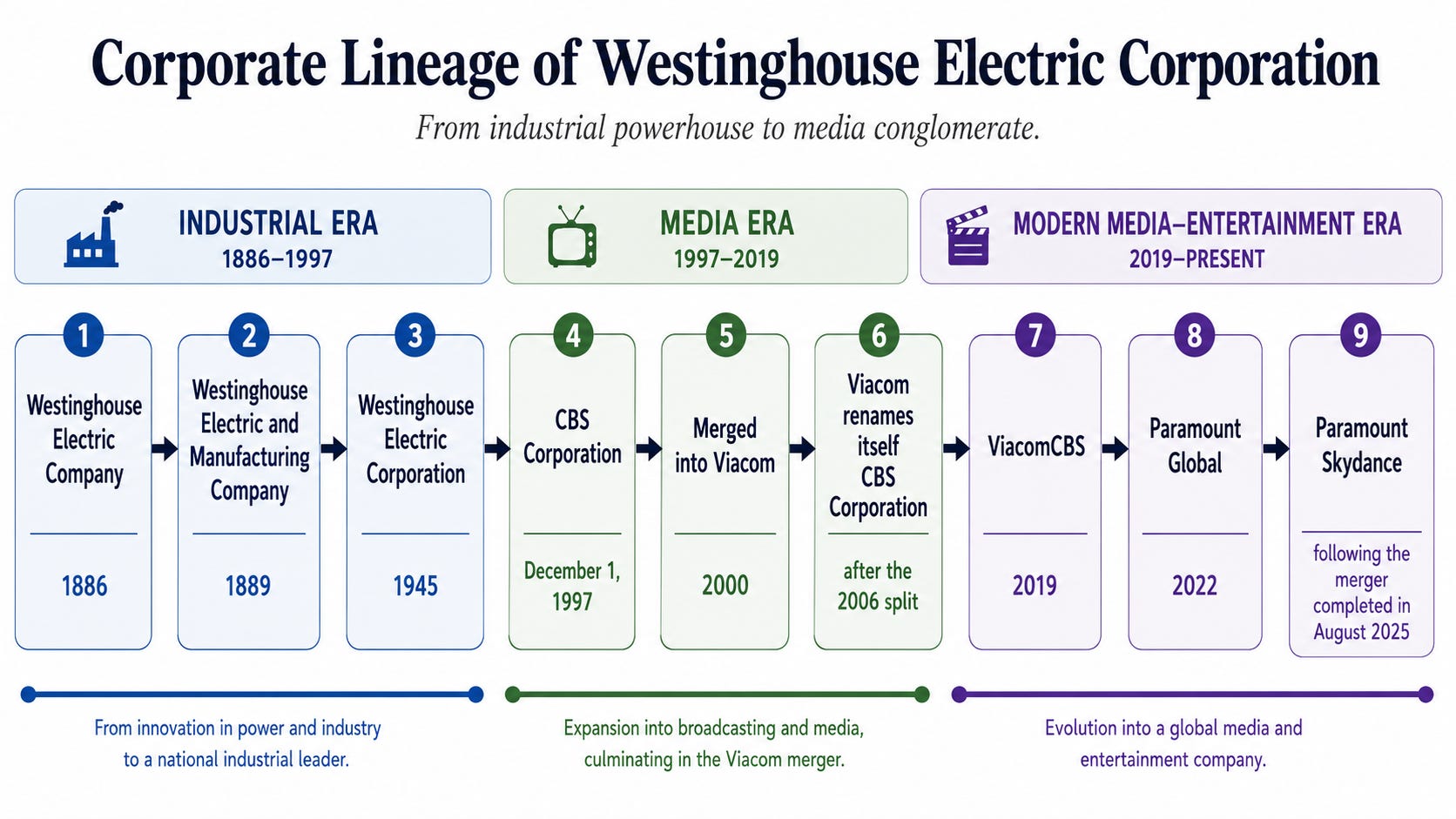
On December 1, 1997, the Westinghouse Electric Corporation’s ticker symbol WX vanished from the New York Stock Exchange, replaced by CBS, the symbol of the television network it had acquired just 2 years earlier. Corporate headquarters moved from Pittsburgh, the Iron City, to New York.
While the nuclear division, amputated from the parent company and sold in 1999, carried the founder’s name and survives as the Cameco and Brookfield owned Westinghouse Electric Company, the corporate lineage runs through legal succession.
By that test the true heir is Paramount Skydance, at the end of the chain from CBS through Viacom. Paramount’s 10-K still discloses roughly 18,000 pending asbestos claims from turbine and marine insulation sold before the early 1970s, and names Westinghouse as its predecessor.
The firm that once built much of the physical apparatus of an industrializing nation now reports its earnings as a broadcaster.
The Origin Story
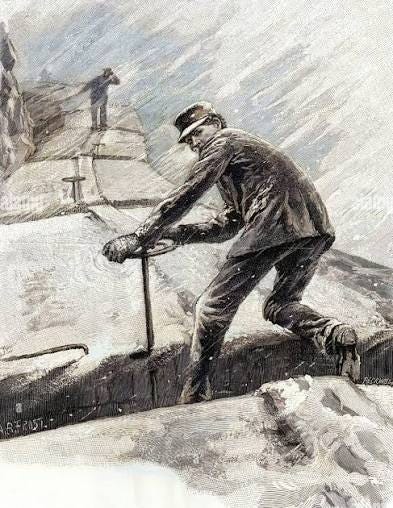
George Westinghouse, the founder of over 60 companies including the Westinghouse Electric Company incorporated in 1886, made the commercial breakthrough that would become the springboard for his next endeavours with the railroad air brake he patented in 1869.
It was a revolutionary technology that replaced the brakeman, who ran along the roofs of moving cars to set each brake by hand, with a compressed-air line that let the engineer stop the entire train in one operation from the locomotive.
Playing with Fire
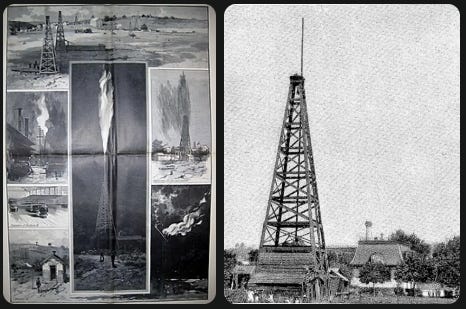
Although best known for his pioneering work in electricity and his victory in the war of the currents, the inventor first took on natural gas. In 1883 Westinghouse drilled for gas in the backyard of his estate in Point Breeze, the affluent East End district where Gilded Age coking coal and ketchup industrialists Frick and Heinz kept their mansions.
He struck a roarer estimated at 20 million cubic feet a day. The well escaped uncontrolled for nearly a week before Westinghouse devised a stopcock and brought it under control.
He then erected a sixty-foot pipe and staged evening illumination tests, sending a pillar of flame another hundred feet into the air. The demonstrations were reportedly bright enough for people a mile away to read newspaper print, but the noise soon prompted Westinghouse to end them.
He went on to invent the reduction valve that let his gas travel through pipes at high pressure and arrive at the home at low pressure, the meter that measured what each customer burned, and the automatic cutoff that shut the main when pressure dropped.
By 1887 his company operated 58 wells and 184 miles of distribution piping serving more than 12,000 homes and 582 industrial customers.
Building the AC grid
The gas business gave Westinghouse direct experience with a networked energy system: production, long-distance transmission, pressure control, metering, leak detection and delivery to dispersed customers.
The reduction valve may have supplied Westinghouse with a useful analogy for AC distribution: carry energy efficiently at high pressure or voltage, then reduce it near the point of use.
Westinghouse financed William Stanley’s improvements to imported European transformers and generators, then licensed Nikola Tesla’s polyphase patents, which supplied AC with what it had lacked: practical motors capable of transforming electricity from a lighting system into a source of industrial power.
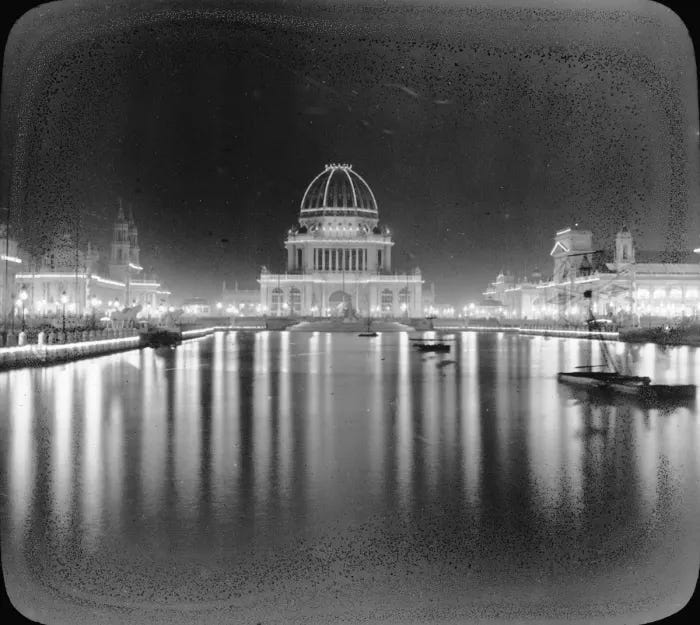
Westinghouse equipment illuminated the World’s Columbian Exposition in Chicago in 1893 and helped harness Niagara Falls two years later. The company supplied the full stack of turbines, generators, transformers, switchgear and motors that began to electrify American society.
George Westinghouse lost control of the company during the financial crisis of 1907 and died in 1914 at the age of 67. By then, Westinghouse Electric employed more than 50,000 people and ranked among the largest industrial corporations in the United States.
Creating Demand for Supply
As the American economy grew a middle class with disposable income, the demand side of electrification opened for business. Utilities of the era were desperate to flatten a load curve dominated by the evening lighting peak. Westinghouse had a double incentive to fill it: every appliance sold was a source of dual revenue as it also represented more electrical load, which meant more orders for the generators and transformers that were the company’s core product.
Radio was the breakthrough household electrical product. In 1920 the company launched KDKA in Pittsburgh, one of the first commercial broadcast stations in the world, in part to give people a reason to buy the Westinghouse receivers sitting in stores.
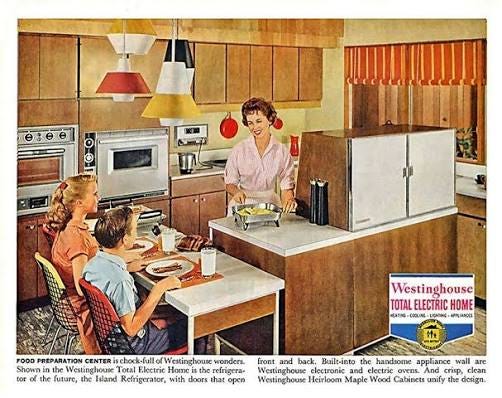
Household amenities followed, including refrigerators, washing machines, stoves, irons, air conditioners and heaters woven into its ultimate branding expression which would delight climate activists today: the “Westinghouse Total Electric Home.”
The Military-Industrial Complex
The state became the next great customer. During the Second World War the company turned its plants over to the war effort, and annual sales climbed from $239 million in 1940 to $835 million by 1944.
That relationship solidified into the postwar procurement structure and Westinghouse stayed inside it with a product catalogue of jet engines, radar, and defence electronics.
The same posture took the company into civilian nuclear power, where the federal government underwrote the early reactor program and absorbed much of its risk. Westinghouse’s Bettis Atomic Power Laboratory, run under contract to the Atomic Energy Commission, developed the pressurized water reactor (PWR) that drove the submarine Nautilus in 1955. When Admiral Rickover was handed the civilian demonstration project, he brought the same lab and the same design with him.
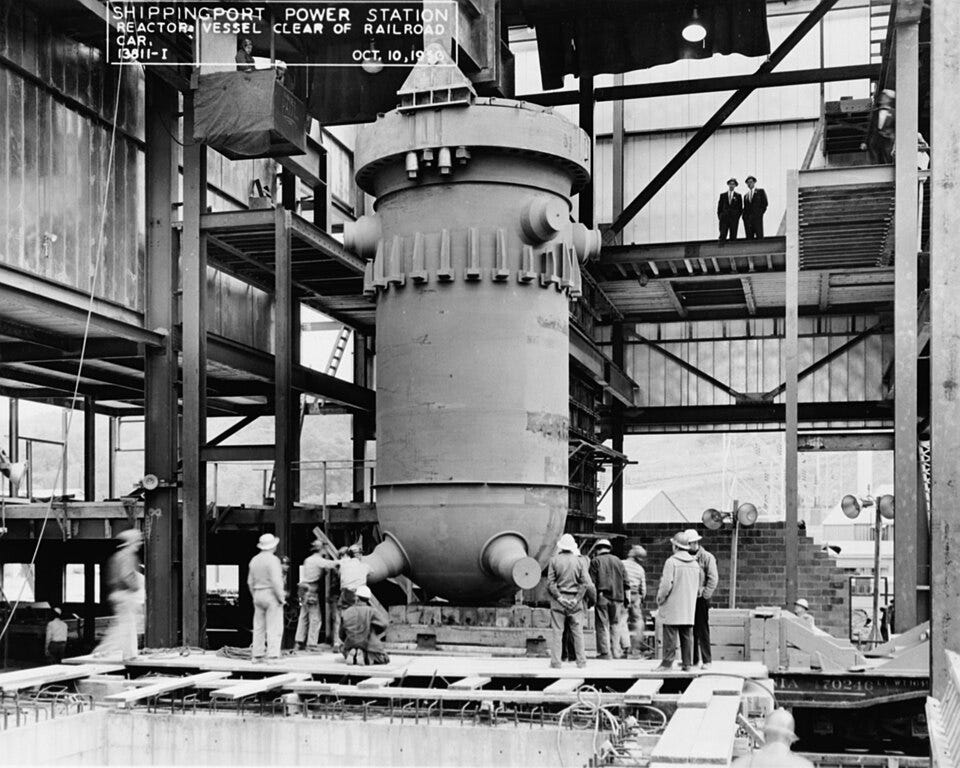
The result was Shippingport which began operating in 1957. The PWR went on to become the dominant commercial reactor design in the United States and around the world.
At its mid-century height the company employed over 100,000 people and was the largest private employer in the Pittsburgh region. Every phase of its growth was reflective of whatever the American economy was organizing itself around: railroads, gas, the grid, consumer durables, then the military-industrial complex and nuclear power.
The Uranium Cartel that Nearly Broke the Business
The decline came in dribs and drabs. Nuclear power was one of the first casualties. To win reactor orders through the 1960s and early 1970s, Westinghouse had sweetened the sales pitch by promising to supply the uranium fuel at fixed prices of around $10 a pound, on the assumption that uranium would stay cheap.
As a result of the 1973 oil embargo and the operations of the “Yellow Cartel,” a government-backed alliance of Canadian, French, Australian and southern African uranium producers, the spot price climbed past $40 a pound.
Westinghouse found itself committed to delivering tens of millions of pounds of uranium that it did not own at a small fraction of what it would now cost to buy. This ultimately resulted in a settlement of approximately $1 billion with 27 utilities paid in cash, uranium, and services.
Next came the downturn in electricity demand, which had been doubling every decade. Construction cost escalation and the regulatory ratchet before and after the Three Mile Island accident added insult to injury and reactor orders dried up.
Foreign and domestic competitors, particularly General Electric, began to take bites out of the heavy electrical equipment sector that had been the company’s core business. Industrial margins compressed across the American economy in the same decade. Westinghouse responded the way much of corporate America did, by reaching for easier returns in finance.
Financialization, Crisis and Rebirth
The Westinghouse Credit Corporation, originally a vehicle to finance purchases of the company’s own consumer products, moved into high-return ventures like hotels, shopping centers, and junk bonds that conventional banks avoided.
For most of the 1980s the financing arm supplied the earnings that its industrial base struggled to produce. When the commercial real estate market crashed in 1990, the company had to absorb more than $1 billion in bad loans, its worst loss since the uranium settlements.
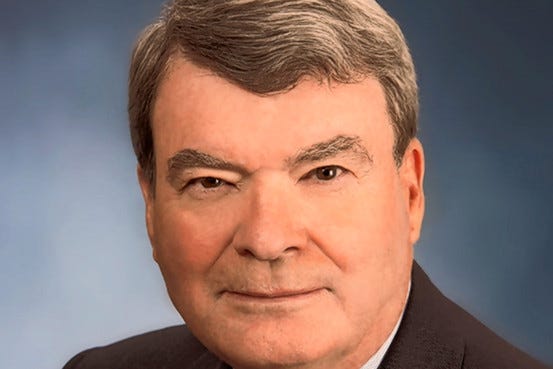
Michael Jordan, president of Frito-Lay and PepsiCo, was brought in to rescue Westinghouse in 1993. He drew a similar conclusion to many managers across the country: manufacturing was a low-growth, capital-heavy business, and media carried higher earnings multiples.
From Yellowcake to Yellowstone
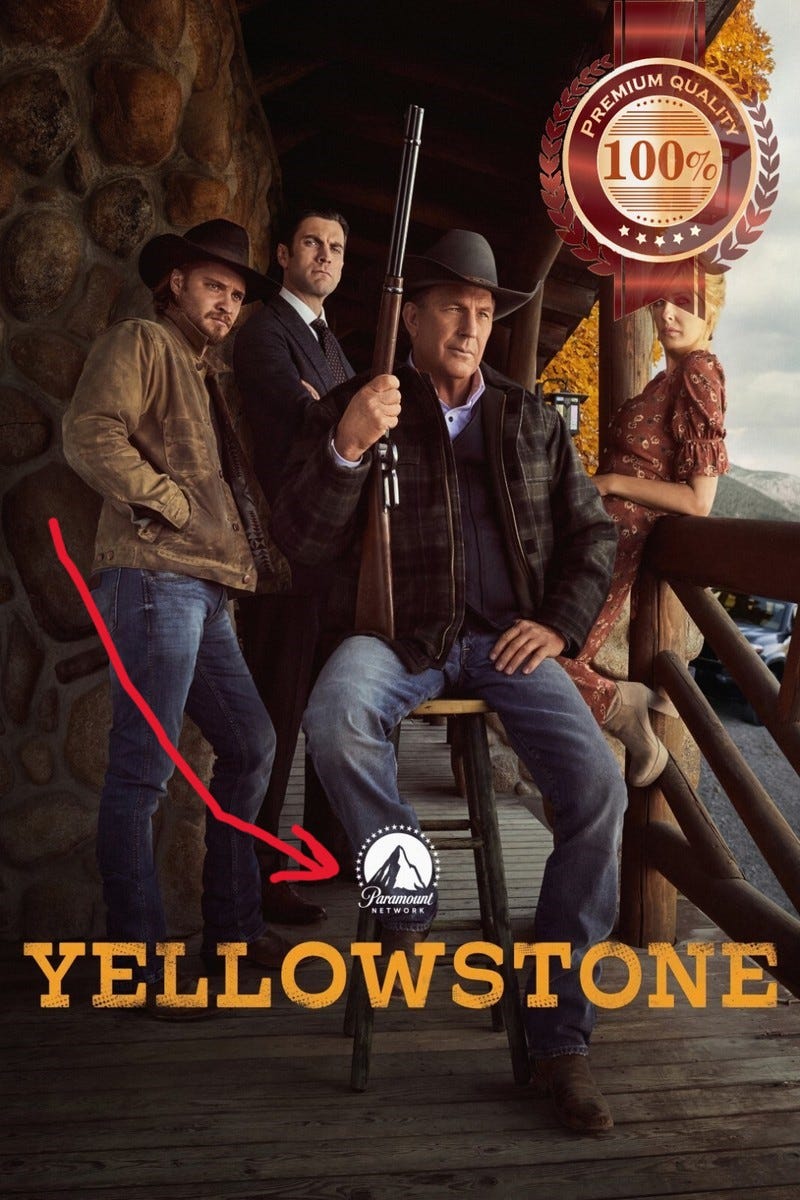
Between 1995 and 1997 Westinghouse spent more than $15 billion buying broadcasters, starting with the CBS television network for $5.4 billion and adding cable channels and radio groups ultimately rebranding as Paramount. It paid for the spree by selling the industrial company piece by piece.
The defence electronics unit went to Northrop Grumman in 1996. Thermo King refrigeration was sold to Ingersoll-Rand in 1997. The power generation business, the turbines that had lit American cities since the 1890s, was acquired by Siemens of Germany in 1998.
The last industrial asset to go was the nuclear business, sold to British Nuclear Fuels Limited (BNFL) in 1999 for $1.1 billion, and the Westinghouse Electric Company name went with it.
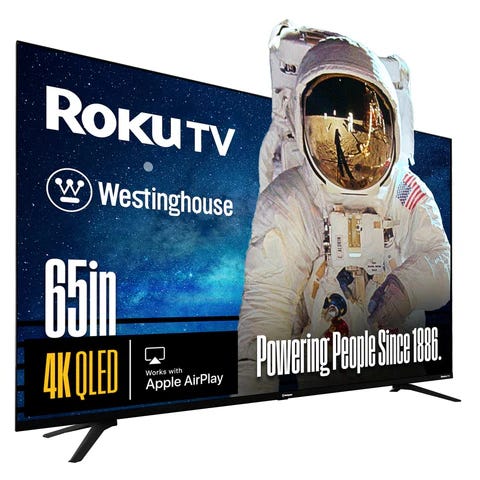
The remaining businesses that bore the great inventor’s name rings particularly hollow. The Westinghouse Licensing Corporation rents the trademark to outside manufacturers for royalties: Westinghouse TV is now part of China’s TongFang global portfolio. Westinghouse generators are designed in the USA but assembled in China and Vietnam.
The Nuclear Revival?
As for the amputated nuclear division, BNFL sold it to Toshiba in 2006 for $5.4 billion, a price that assumed a nuclear construction revival. The revival came eventually, but not in the United States.
That same year China chose Westinghouse’s flagship AP1000 as the technology base for its generation 3 reactor program. The price was the design itself. Toshiba, which had completed its purchase of Westinghouse weeks before the agreement was signed, handed some 75,000 technical documents to the State Nuclear Power Technology Corporation, a firm Beijing created for the purpose, and conceded Chinese intellectual property rights to any derivative above 1,350 MWe.
China absorbed the design across the four first-of-a-kind units, drove domestic content past 90%, and named the indigenized version the CAP1000. As of 2026, the four original AP1000s are operating, the first CAP1000s are in commissioning, roughly a dozen more are under construction on 5-year build schedules, and the CAP1400, the larger derivative China owns outright, is entering service.
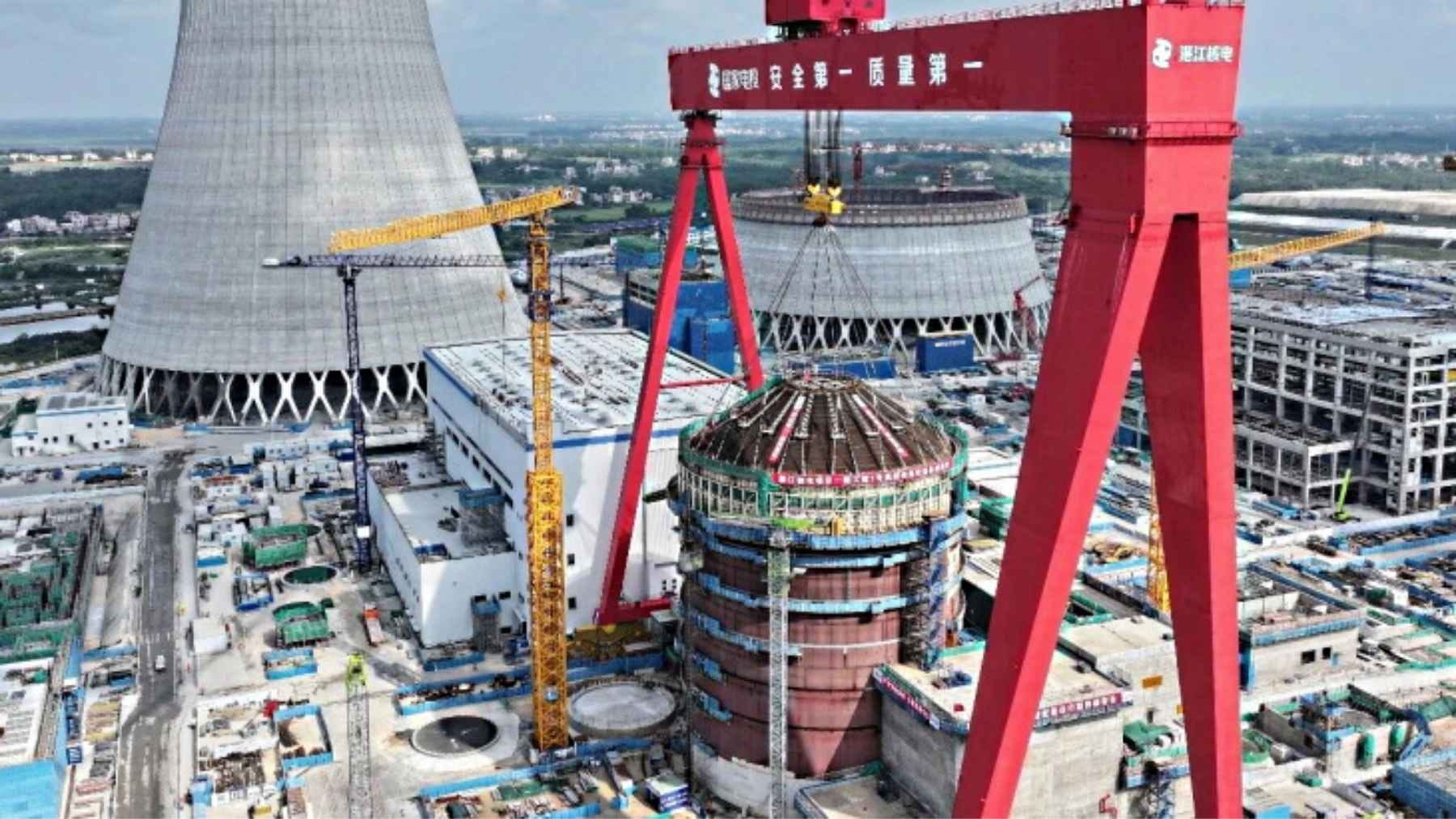
Toshiba’s Westinghouse went bankrupt building four AP1000s in the USA. The fixed-price construction contracts it absorbed in 2015 coupled with an incomplete design during construction and poor module fabrication at a hollowed-out domestic supplier put the company into Chapter 11 bankruptcy in 2017. Only the two reactors at Vogtle were ultimately finished.
More recently, Brookfield Business Partners bought Westinghouse out of bankruptcy in 2018 for $4.6 billion and sold it in 2023 to Cameco and Brookfield Renewable Partners for $7.9 billion including debt.
The Metamorphosis and the Chinese Butterfly
Westinghouse engineered much of the gas network and the electric grid when the United States led the world in heavy industry and manufactured home appliances for a burgeoning consumer society. It armed the state and built reactors when federal procurement organized the postwar economy and it financialized when industry and manufacturing profits stalled. Finally, it liquidated its entire industrial stack to become a content creation and streaming company as the US economy offshored much of its industrial base.
Now 30 years after the Westinghouse ticker WX disappeared from the New York Stock Exchange its hived off nuclear division is returning into the public markets.
The irony of whatever valuation the Westinghouse Electric Company achieves is that a little over a century later the industrial ambition its namesake the great George Westinghouse embodied is practiced most successfully not by American private capital, but by the state-directed industrial capitalism of the People’s Republic of China.
Like this post! You don’t have to choose between entertaining writing and industrial literacy.
The four of us here have worked on hundreds of brownfield sites like the one you pictured at the top.
Not sure what's worse. That image and what it represents, or "the irony" at the end.
In between the incredible, relentless innovation and job creation and the current irony, many dignified American middle class lives were built.
It seems as though what industrial might the U.S. still maintains revolves around energy. Not just its production and distribution directly, but what abundant, affordable, reliable energy does to attract large capital investment in certain industries.
Great post, Chris.
An excellent and well written history. I have been a fan of George Westinghouse, one of the greatest power engineers ever, my entire life. Also interested in the history of power generation. This is outstanding and I will save for reference. Thank you!