

I’ve long thought of myself as an energy determinist, perhaps even something of an energy reductionist, inclined to explain the extraordinary hockey stick of economic growth over the last several centuries primarily through the lens of the increasing availability of the “holy trinity” of coal, oil, and gas.
As my friend Doomberg regularly opines, “Energy is Life.”
More recently, however, I’ve become something of a prime mover determinist, for energy alone can accomplish remarkably little without the means to transform it into useful work.

Plutarch recounts that during Alexander the Great’s conquests of the Middle East, he marveled at the flammability of the petroleum seepages he encountered in Mesopotamia. However, beyond primitive incendiary applications, later developed into Greek Fire, petroleum remained little more than a curiosity for Alexander, who had no tanks or trucks with Otto or Diesel engines to harness this fossilized sunlight and turbocharge his force projection through mechanized mobility.
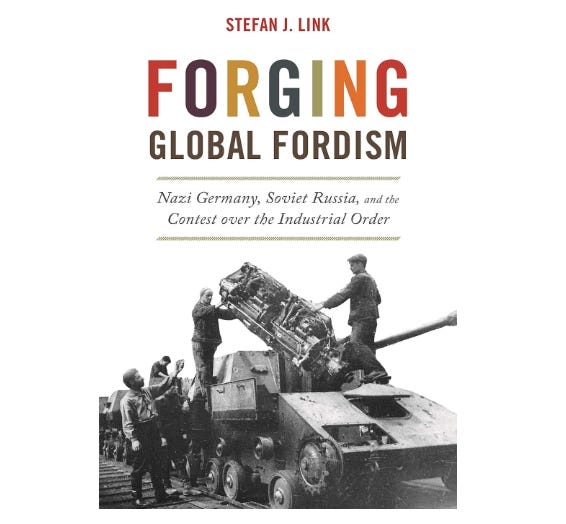
After reading @Stefan Link’s Forging Global Fordism at the suggestion of subscriber Engineer Guy, I am now firmly in the camp of the manufacturing determinists. The invention of prime movers accomplishes relatively little until they can be mass produced cheaply and in enormous quantities.
Before Ford, automobiles were luxury playthings and status symbols for the wealthy elite. Ford’s revolutionary assembly-line manufacturing transformed these expensive novelties into ubiquitous prime movers and, I’d argue, enabled the greatest productivity revolution in human history.
Early automobile manufacturing resembled the assembly of a bespoke carriage. Skilled craftsmen painstakingly assembled engines, transmissions, and bodywork from poorly standardized parts, adjusting components by hand as they moved around largely stationary vehicles.
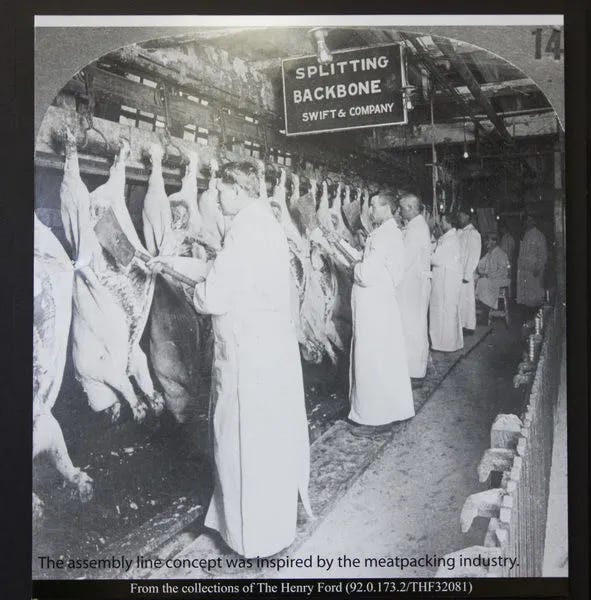
Ford drew inspiration from the disassembly lines of Chicago’s meatpacking plants, where carcasses hung from overhead trolleys passed stationary butchers. He reversed the process, adding rather than subtracting parts as an increasingly complex machine moved down the line and finally came to life. At his Highland Park factory in 1913–14, relentless refinement of this principle reduced Model T chassis assembly time from roughly twelve hours to just ninety-three minutes.
Electrification laid the material foundation for Ford’s revolution. The development of practical electric motors in the late nineteenth century, pioneered in part by Nikola Tesla, eventually made possible what became known as unit drive: powering individual machines with their own motors rather than through cumbersome networks of shafts, pulleys, and belts driven by a central steam engine.
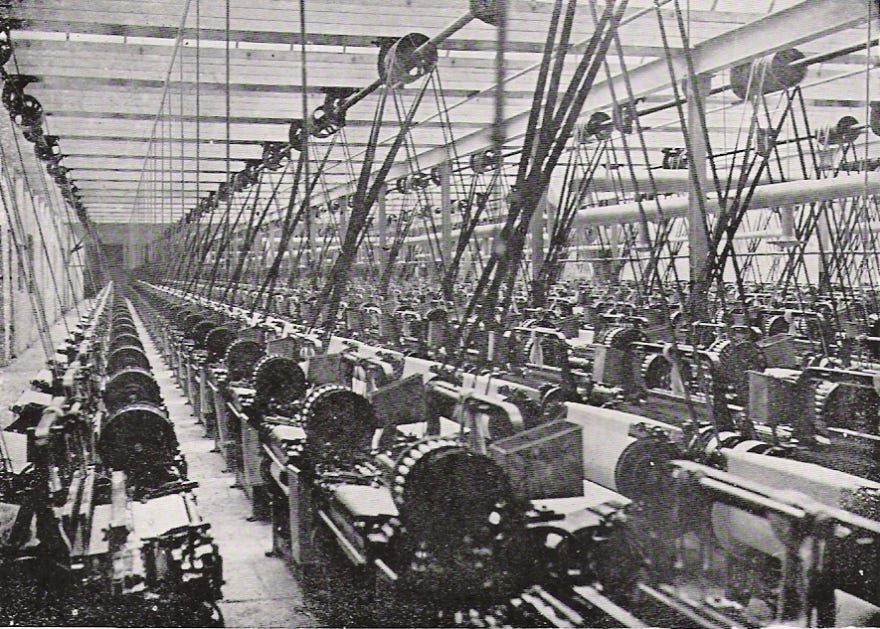
This liberated machinery from the restrictive geography of steam-based power transmission, allowing factories to be reorganized around the sequence and flow of production itself. Combined with interchangeable parts and precision machine tools, it helped transform carmaking from a craft into a tightly coordinated industrial process.
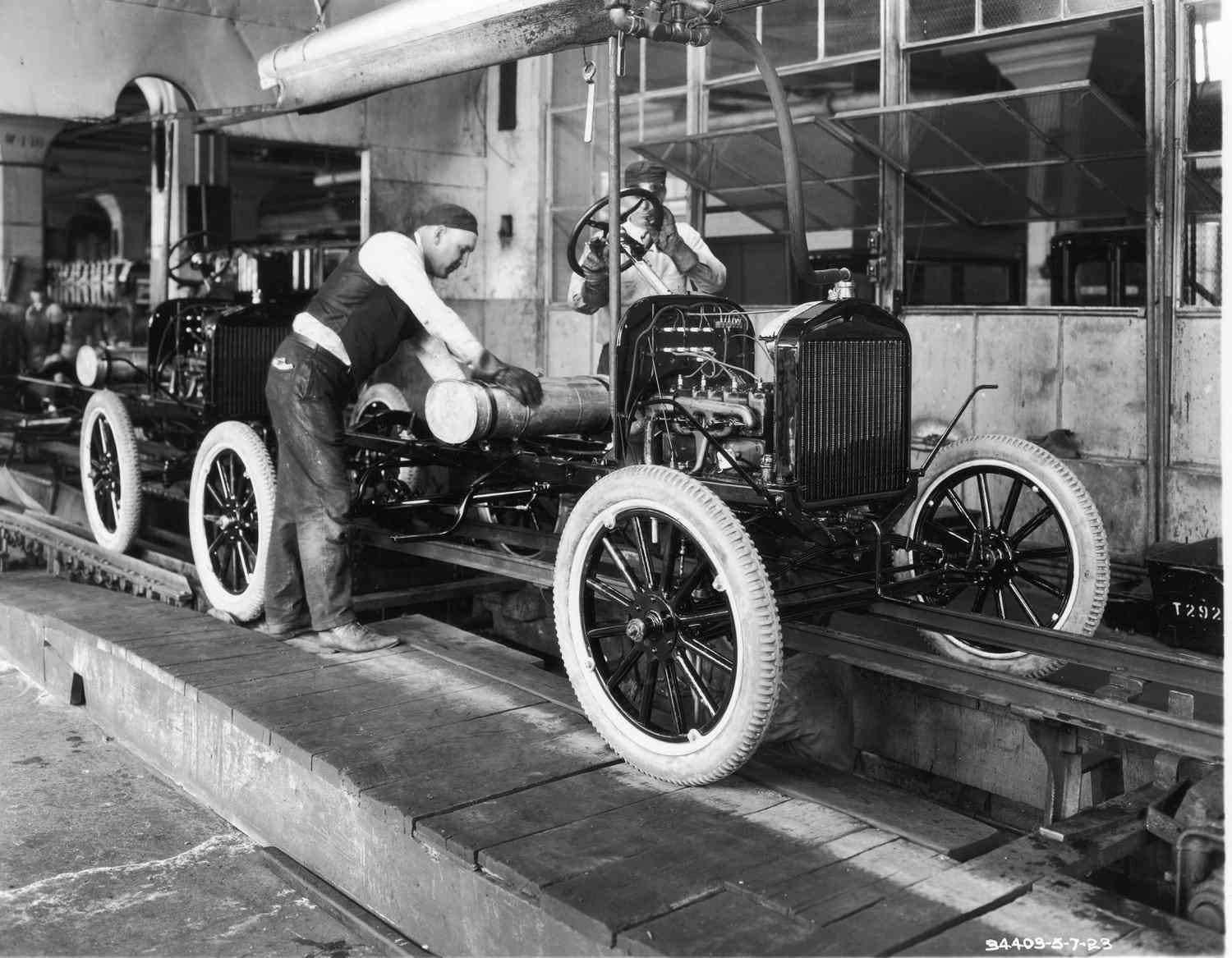
Ford’s worker productivity revolution was the consequence of a radical division of labour.
On one side, an engineering elite designed and distributed sophisticated, expensive machine tools along the line, justifying their costs with enormous production runs. One example was a multi-spindle drilling machine that could simultaneously create 45 holes in an engine block from four different angles, compressing what had once required numerous separate machining operations into a single, precisely choreographed mechanical act completed in minutes.
On the other, unskilled workers, many newly arrived immigrants largely drawn from an agricultural labour pool, performed mind-numbing simple, repetitive tasks. The genius of Fordism was that, by embedding craftsmanship in the machinery and organization of the factory, unskilled labourers could collectively replicate the work of master craftsmen at a fraction of the cost and in vastly greater volumes.
But the productivity revolution did not end at the factory gates. The farmer who abandoned his fields for the assembly line was now helping manufacture the tractors, trucks and agricultural machinery that would replace his own labour back on the farm. His departure no longer meant a corresponding loss of agricultural output. Instead, the remaining farmers could cultivate vastly more land with far fewer hands.
Consider the sheer multiplication of mechanical power. A human being engaged in sustained physical labour generates roughly 100 watts; a horse, 500–1,000 watts. The engine of a typical family car can deliver more than 100,000 watts at full output. Make that kind of power ubiquitous in the form of a tractor or combine harvester, and a single farmer can cultivate and harvest land that once demanded the backbreaking labour of hundreds.
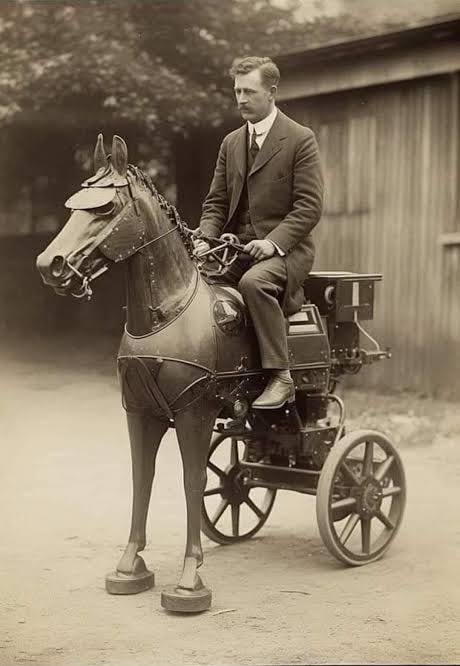
Extend this revolution to freight transport, construction, earthmoving and the colossal machinery of modern mining, and one begins to appreciate how thoroughly mechanical power has multiplied human productive capacity.
And critically, machines multiply machines. Excavators mine the iron ore, locomotives transport it, steel mills refine it, and precision machine tools transform it into still more machinery. Fordism thus revolutionized productivity twice: first in the factory that produced the machine, then in the fields, mines, and workshops where that machine was put to work in an ever-accelerating, self-reinforcing cycle.
Mass motorization did more than multiply the power of human labor; it also collapsed the tyranny of distance that had once restricted the movement of people and goods. Railways had already conquered continents, but the internal-combustion engine carried that revolution beyond the railway station, reaching into every farm, factory, village and household.
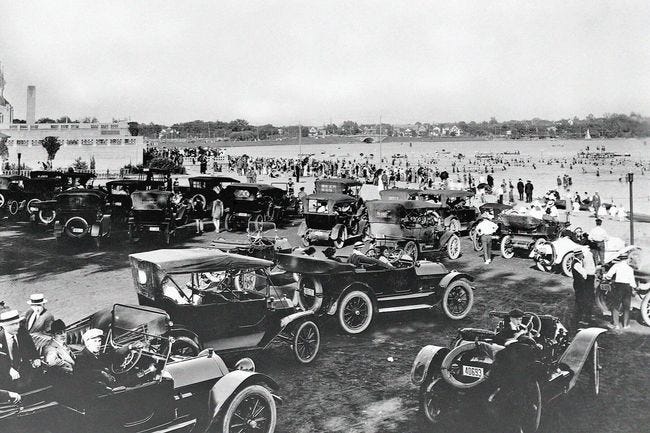
The scale of that transformation was staggering. According to the U.S. Federal Highway Administration, motor vehicles collectively traveled a mere 100 million miles on American roads in 1900. Thirty years later, they traveled 206 billion miles annually, a more than 2,000-fold increase.
By 1927, some 23 million motor vehicles traveled America’s roads, compared with barely 18,000 in the Soviet Union and fewer than half a million in Germany.
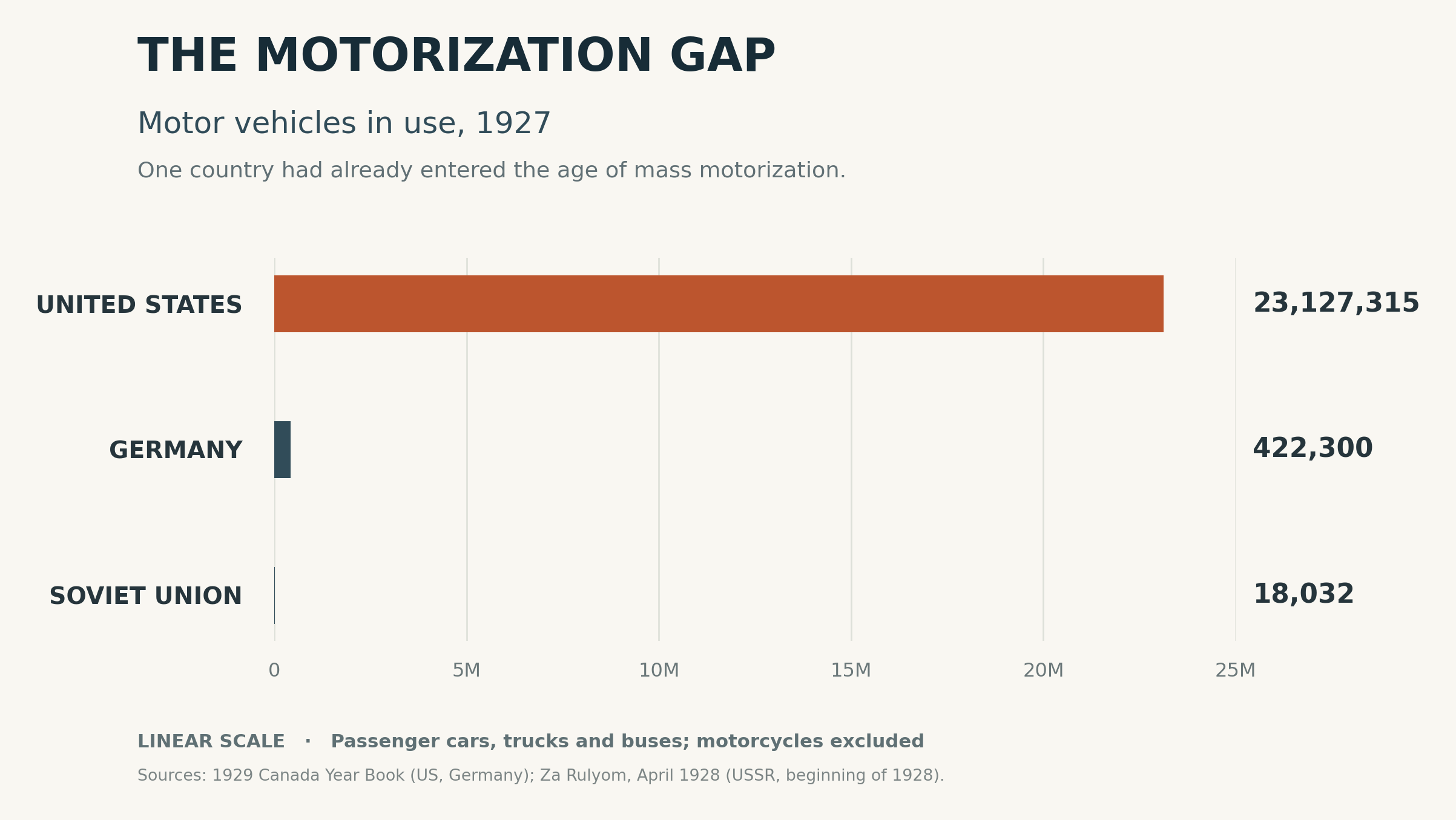
The productivity gap was staggering, and increasingly recognized as a profound economic and strategic vulnerability. The Soviets in particular had no intention of remaining trapped in a subordinate position in the international division of labour. They refused to accept a future in which they exported grain and raw materials to pay for the sophisticated machinery of more advanced industrial economies, forever confined to their supposed comparative advantage.
Such dependence threatened to become self-perpetuating, and with the winds of another European war already stirring, industrial backwardness was beginning to resemble not just an economic liability but an existential threat.
Mastering American mass production became an urgent national priority. In the coming age of mechanized warfare, the gulf between industrial powers and industrial laggards threatened to become as decisive as the advantage Cortéz possessed over the Aztecs.
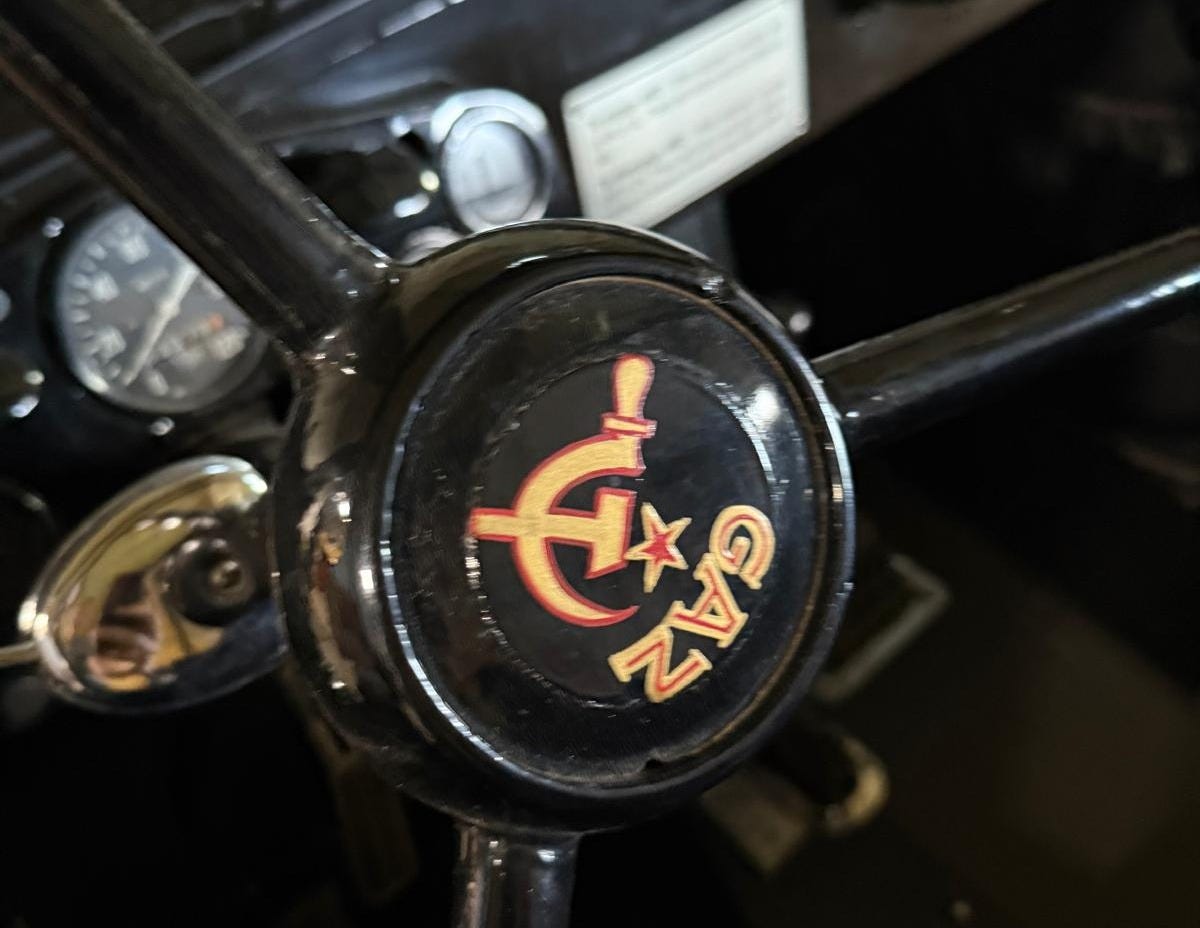
What followed was one of history’s most consequential episodes of industrial technology transfer. Engineers and industrial planners descended on Detroit to study, imitate, and recruit some of Ford's top talent. River Rouge-inspired, vertically integrated industrial giants arose in the Soviet Union and Germany in the 1930s as Europe raced to close the mechanization gap.
World War II became what historian Stefan Link and others call the “War of the Factories,” the ultimate proving ground for rival Soviet and Nazi adaptations of Fordism, where the capacity to mass-produce trucks, tanks, aircraft, and armaments proved as decisive as the armies wielding them.
In our next essay, we’ll explore how Ford’s political philosophy, which subordinated shareholder returns to the imperatives of production, captivated social democrats, Nazis, and Soviets alike, as well as its contemporary relevance in the era of Western financialization and industrial decline and the astonishing rise of Chinese developmental capitalism.
Like this post if you think it deserves a Ford-star rating.
Buy Stefan Link’s Forging Global Fordism here https://www.amazon.com/Forging-Global-Fordism-Germany-Industrial/dp/0691177546
Good post. It didn't start with Ford, though--what was called the American System of Manufacturing emerged in the early 1800s and encompassed specialized machine tools, jigs/fixtures, gauges for tolerances, division of labor among semi-skilled workers, and assembly of standardized parts with minimal hand-fitting. An example was Eli Terry's manufacturing of clocks in volume---A clock that cost a skilled household a month or more of wages in the 1790s became a few days’ pay by the 1810s and roughly a day’s wages by the 1840s. That is why ownership jumped from a rarity (roughly one family in ten around 1793) to a common household object that peddlers sold door-to-door across the country and later exported by the hundreds of thousands.
On a broader scale there's a whole field of study on what has determined economic growth. One of my favorite books on this subject is Lipsey, Carlaw ans Bekar's (Canadians!) Economic Transformations. They identify a series of what they term general purpose technologies (e.g. printing press, steam engine, electricity) whose application throughout the economy provide quantum boosts.