

The Advanced Boiling Water Reactor (ABWR) was built in just 38 months of nuclear construction but after its lightning deployment in Japan it failed to lift off internationally. What happened?
To understand the context and success story of the world’s most rapidly constructed reactor, let’s hop in the Decouple time machine with James Krellenstein. We’ll set the timer to the late 1990s and consider the view from inside the global nuclear industry.
The American and European reactor construction booms of the 1970s and 1980s have run their course. Western utilities, saturated with capacity after decades of rapid industrial build-out, have stopped ordering reactors. Chernobyl has done its political damage.
The French Messmer programme has delivered 54 reactors in roughly 15 years, but Paris is now operating a mature fleet, and not expanding it. In the United States all reactor orders placed after 1973 have been canceled. The word most commonly attached to nuclear construction, on both continents, is “pause.”
Japan is an exception. It is the world’s second largest economy dependent on imports for 90% of its energy needs. Driven by energy security concerns it has developed a national target of 50% nuclear electricity by 2030. Japanese utilities have continued building at scale as the West has stood down.
TEPCO, the Tokyo Electric Power Company, operates large multi-unit sites at Fukushima Daiichi, Fukushima Daini, and the world’s largest nuclear generating site, Kashiwazaki-Kariwa. It has brought a systematic industrial discipline to the task that its Western counterparts have largely abandoned.
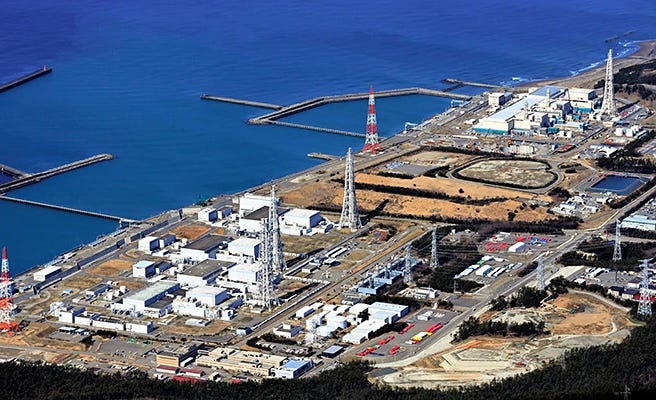
At Kashiwazaki-Kariwa, units 6 and 7 come online. They are ABWRs, 1350 MWs each and the world’s first Generation III reactors. The first of a kind (FOAK) unit is built in 38 months of nuclear construction and costs roughly a third less than unit 5, a seventh-of-its-kind standardized BWR5 Mark II, built at the same site by the same construction crews, essentially simultaneously.
This stellar result sets the benchmark for the EPR designers at Framatome and the AP1000 team at Westinghouse. Both programmes publicly aim for 36-month construction schedules. As Krellenstein observes, this prompts a reasonable inference: if the Japanese can build a FOAK Gen III reactor in 38 months with 1990s digital tools, why couldn’t the West?
The ABWR appeared to prove that the obstacles plaguing nuclear construction in the 1970s and 1980s were not intrinsic to the technology. They were interpreted primarily as problems of document management, design coordination and supply chain integration, precisely the problems that the information technology revolution of the 1990s was supposed to have solved.
A Controlled Experiment
When Olkiluoto 3 began construction in 2005 as the first EPR, the Western nuclear industry had the same computers, the same CAD software, the same building information modelling tools, and the same AutoCAD and Primavera and Navisworks that Japan had used to build Kashiwazaki Kariwa 6 and 7.
Commodity laptops were faster than anything available when TEPCO planned its first ABWR. Adobe Acrobat was on every engineer’s desktop. Radio frequency identification (RFID) inventory management became standard practice in manufacturing supply chains across the developed world.
However, results in the West differed markedly from the Japanese experience. Finland’s Olkiluoto 3 took 18 years from construction start to grid connection. The Vogtle AP1000 units in Georgia, the only AP1000s completed in the United States, ran roughly 7 years late and billions over budget, bankrupting Westinghouse in the process.
The EPR at Flamanville in France, begun in 2007, achieved grid connection only in 2024. These projects were assembled after a long pause, dependent on teams, supply chains, and regulators lacking recent experience in delivering nuclear megaprojects.
Digitalization was necessary for Japan’s impressive achievement, but it was only one variable in the stack. Japanese nuclear construction continuity into the 1990s conserved a workforce with recent build experience, project managers who had closed out large units, and a supply chain still qualified and synchronized to nuclear specifications.
Kashiwazaki Kariwa 6 and 7 were successive iterations of an ongoing construction program. Japan demonstrated pre-construction discipline, an integrated supply chain, the utility as developer model, and above all spent more than a decade on pre-construction design and constructability work.
The 1978 Tokyo Meeting
The ABWR originated in a TEPCO feasibility study commissioned in 1978, 13 years before construction began at Kashiwazaki-Kariwa. TEPCO brought together every major boiling water reactor developer in the world: General Electric, Hitachi, Toshiba, the Italian firm Ansaldo, and the Swedish firm ASEA, which had independently developed BWR technology without a GE licence, deploying it at Forsmark, Ringhals, and Oskarshamn.
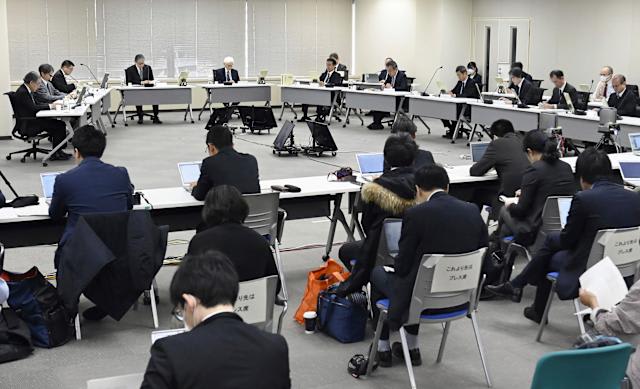
Such cooperation was deliberately radical for an industry organized around vendor competition. TEPCO was paying its vendors to make their existing designs obsolete in order to secure the next one.
The premise underlying their assignment was expressed in one question: if you could redesign the boiling water reactor from scratch, drawing on everything the global BWR fleet had learned about construction and operation, what would you change?
That meeting produced the conceptual design that eventually became the ABWR. Its underlying philosophy was simple: build what the utility could actually construct, validate, operate, and understand, using proven components and methodologies available at the time, and eliminate complexity wherever it did not buy proportionate safety or performance.
This is quite different from the philosophy that produced the AP1000, which emerged primarily from US government-funded research into advanced passive safety concepts. The AP1000 is revolutionary in its passive safety architecture. The evolutionary ABWR made design decisions driven primarily by the needs of a utility aiming to build at scale.
The Design Philosophy
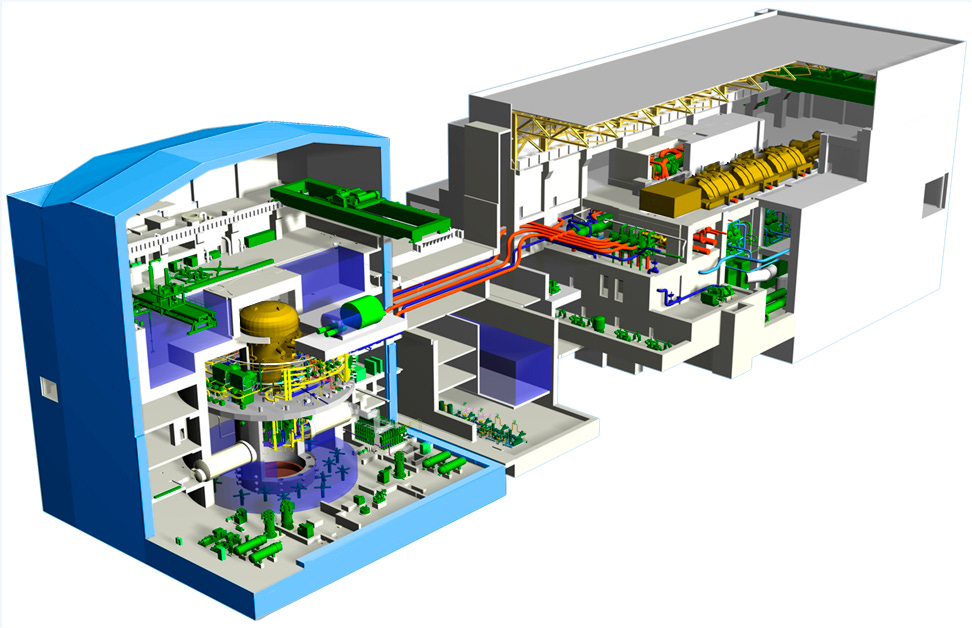
The ABWR containment building is a squat cylinder of reinforced concrete, shorter than the turbine building on the same site. Height is both a key driver of cost and an enemy of seismic resilience. Japan’s geology demanded a short, stiff structure.
The free volume of the ABWR containment is roughly 1/5th that of an equivalently sized PWR, 450,000 cubic feet, compared to 2.5 to 3 million cubic feet in an equivalent pressurized water reactor. Most of this reduction in containment volume is intrinsic to boiling water reactor design: with the elimination of steam generators, pressurizer, hot legs, or cold legs. However, the elimination of external recirculation pumps reduced containment size further relative to other BWRs.
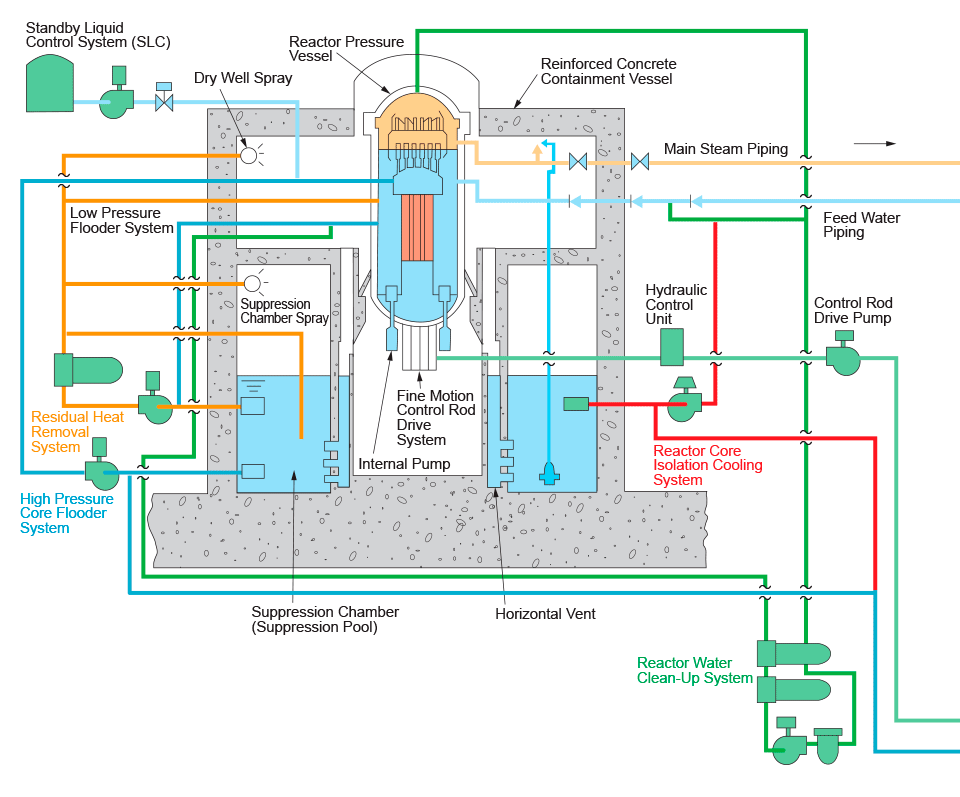
Perhaps the most revealing design choice of the ABWR is the reactor internal pump, or RIP. To understand why, it is worth recalling what came before.
Boiling water reactors benefit hugely from recirculation flow. In a BWR, water in the core is both coolant and neutron moderator. Steam bubbles, which are roughly 100 times less dense per unit volume than liquid water, weaken moderation and reduce reactor power. Controlling the void fraction in the core (reducing steam bubbles) is therefore a primary mechanism of power control.
The way to do this is to drive recirculation flow through the core: pushing water through the fuel at high velocity sweeps bubbles away and increases moderator density. An extraordinary illustration of the importance of recirculation flow is the fact that its flow rate dwarfs the feed water flow rate, that is the water returning to the reactor pressure vessel from the turbine condenser, by a factor of 5-7.
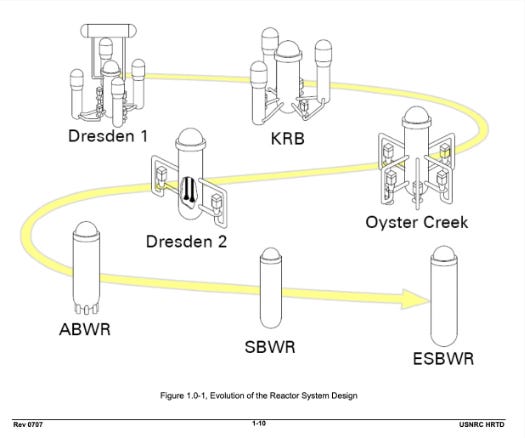
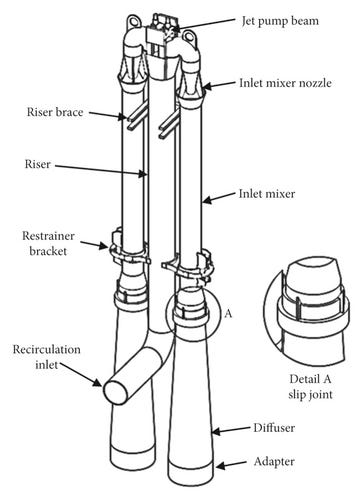
Early BWRs accomplished this with large external recirculation loops: pipes carrying reactor water out through the vessel wall, through pumps, and back in at the bottom. GE’s BWR3 through BWR6 product lines replaced those loops with jet pumps: 2 external recirculation pumps driving high-velocity jets into a Venturi throat, with surrounding water entrained by the Bernoulli effect, multiplying the flow without multiplying the large-diameter pipe penetrations. Most operating BWRs in the United States today possess this configuration.
The ABWR went further. Drawing on technology pioneered by ASEA on the Swedish fleet at Forsmark, designers eliminated external recirculation entirely, replacing it with 10 RIPs mounted on the bottom skirt of the reactor pressure vessel. The RIP motors sit outside the vessel; the impellers are on the inside, driven through the lower skirt. There are no recirculation loop pipe penetrations. The only fluid penetrations below the midpoint of the nuclear fuel are the RIP penetrations themselves, which are far smaller in diameter than the large recirculation piping they replaced.
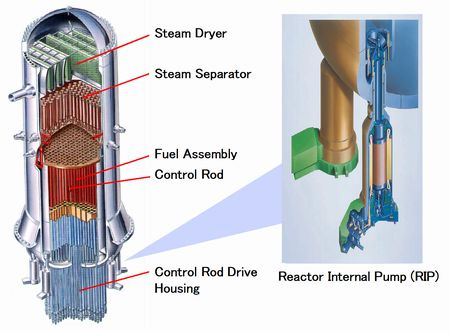
The resultant safety gain is real: recirculation line breaks contributed significantly to large break loss-of-coolant accident probability in earlier BWR designs. The ABWR eliminates that category of event entirely. But more importantly, as far as construction is concerned, is the simplification of the reactor building layout.
Removing the recirculation loops removes a substantial volume of large-diameter, nuclear-quality piping from the containment building, along with all the associated weld inspections, seal packages, and QA documentation. Every weld eliminated is a weld that cannot introduce a defect, cannot require a repair, and cannot become an inspection item for the regulator.
Operational consequences are equally significant. Each of the 10 RIPs is individually controlled by a variable frequency drive. By increasing pump speed and raising moderator density uniformly across the core, the reactor can move from 60% to 100% power in roughly 2 minutes without moving a control rod.
Krellenstein notes that this ramp rate is comparable to a combined-cycle gas turbine. Because the power change spreads evenly across the core, it avoids the local “hot spots” in neutron activity that happen when control rods are pushed in from specific locations.
The late-cycle “xenon pit” problem, which normally limits a reactor’s ability to ramp power up and down near the end of its fuel cycle, is less restrictive in the Advanced Boiling Water Reactor. Its internal recirculation pumps increase moderation in a way that preserves enough reactivity margin to keep adjusting power smoothly right up until the final coast-down period.
Thus, in a single piece of hardware, RIPs constitute a safety improvement, a construction simplification, a maintenance reduction, and an operational flexibility gain. That combination is the physical manifestation of ABWR’s pragmatic design philosophy.
The Original Large Modular Reactor
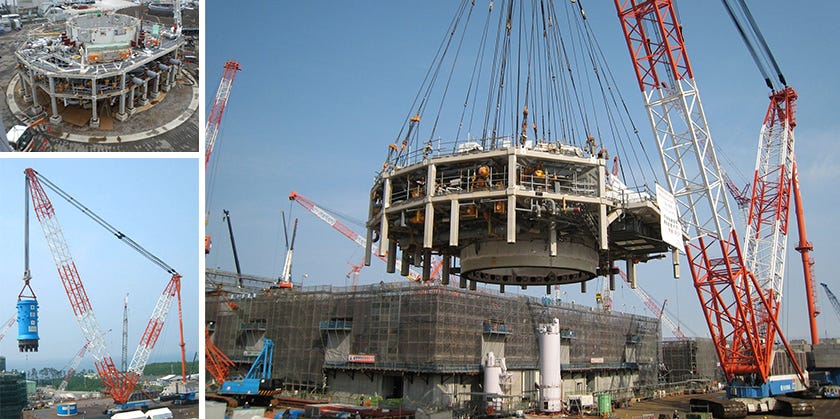
The ABWR is a large modular reactor. That framing matters because modularity is currently marketed as a defining advantage of small modular reactor designs, as though off-site prefabrication become available only below a certain nameplate capacity. The ABWR demonstrated otherwise at 1,350 megawatts.
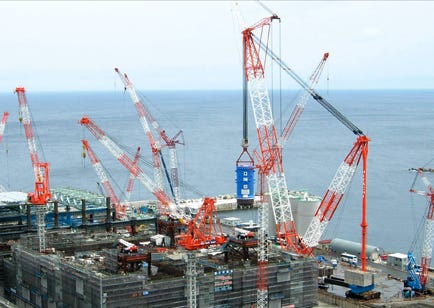
Every unit ever built, including the Lungmen plants in Taiwan, was constructed on a bargeable site, with a large crawler moving directly from the barge slip to place the entire bottom section of the containment as a single piece onto the foundation. The fabrication shops producing those modules were inside the same “Zaibatsu” vertically integrated conglomerates as the design organizations, so the integration between what was designed and what could actually be shipped and placed was well understood.
The modularization schema was deliberately flexible, which turned out to matter more than the degree of modularization on any given unit. The first ABWRs were more stick-built, with prefabrication increasing on the third and fourth plants as construction teams learned what the approach could and could not do. When the hydraulic control units, initially modularized as a single prefabricated room, proved harder to execute that way than anticipated, the teams pulled back and stick-built them instead.
In a Western programme governed by fixed contract milestones and adversarial relationships between the utility, the architect-engineer, and the vendors, that kind of adjustment generates claims and schedule impacts. At Kashiwazaki-Kariwa it generated a revised work package, because TEPCO owned the design and bore the consequences of getting it wrong, which meant it also had the authority to fix it without litigation.
Four Hours Sharpening, Two Hours Cutting
The ABWR’s extraordinary built time was largely due to pre-construction planning. 13 years of design development, regulatory engagement, supply chain preparation, and digital pre-construction work occurred prior to nuclear concrete being poured.

By the time Kashiwazaki-Kariwa 6 broke ground, the design was finalized. Every cable tray, every pipe penetration, every weld sequence, every construction work package had been resolved in the digital model. Worker congestion through the construction sequence had been reduced. Concrete pours had been scheduled to the seasons to meet weather requirements. The entire warehouse inventory was managed by RFID. QA travellers and field work packages were transmitted to Palm Pilots on site rather than managed through paper binders.
From rock inspection to commercial operation, every subsequent ABWR built in Japan was completed within roughly 40 to 50 months. The 4 Japanese ABWRs operational by 2006 were built at a staggering rate of approximately 28 megawatts per month of construction time, or roughly 1 MW per day. For sake of comparison Vogtle Unit 3 was only 9 MW/month and the Flamanville EPR 8 MW/month.
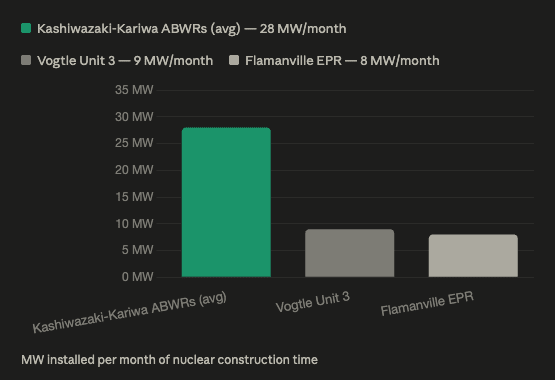
The standard aspiration of nuclear construction improvement is a learning curve story: the FOAK is hardest, and each subsequent unit gets cheaper and faster as the builder learns. The ABWR bucked that trend. Its FOAK was a third cheaper than the seventh of a kind predecessor it replaced. The learning happened in the context of an active build program and 13 years of construction-informed design work before ground was broken, not in the field afterward.
In contrast the AP1000 and EPR were not merely unfinished designs when they entered the field, they were attempting to compress the Japanese pre-construction process into the construction schedule itself. They paid for every unresolved interference and every incomplete work package in real time, with tradespeople standing idle and interest during construction sky rocketing.
The failure to export the ABWR
In 2003, Finland’s utility Fortum selected the EPR over the ABWR for Olkiluoto 3. The EPR slightly underbid the ABWR, and from the perspective of a utility making a 2003 decision, the choice was not obviously wrong.
Kashiwazaki-Kariwa 6 and 7 were already operating as reference plants, but the industry had not yet absorbed what its benefits were. The prevailing and seemingly reasonable assumption was that the industry could now expect Gen III construction performance in the 36-to-38-month range. Olkiluoto 3 was supposed to be the proof point for the EPR just as Kashiwazaki-Kariwa had been for the ABWR.
The Olkiluoto 3 result is now part of a sorry historical record: 14 years late and roughly 3 times the original budget.
Would these outcomes have been partially avoided if The ABWR had been built in Finland or the United States? The ABWR had genuine advantages that the EPR and AP1000 lacked at first pour. The Lungmen units, 2 ABWRs built in Taiwan, that although never allowed to operate for political reasons, were built to ASME codes and represented a direct analogue to a Western regulatory environment.
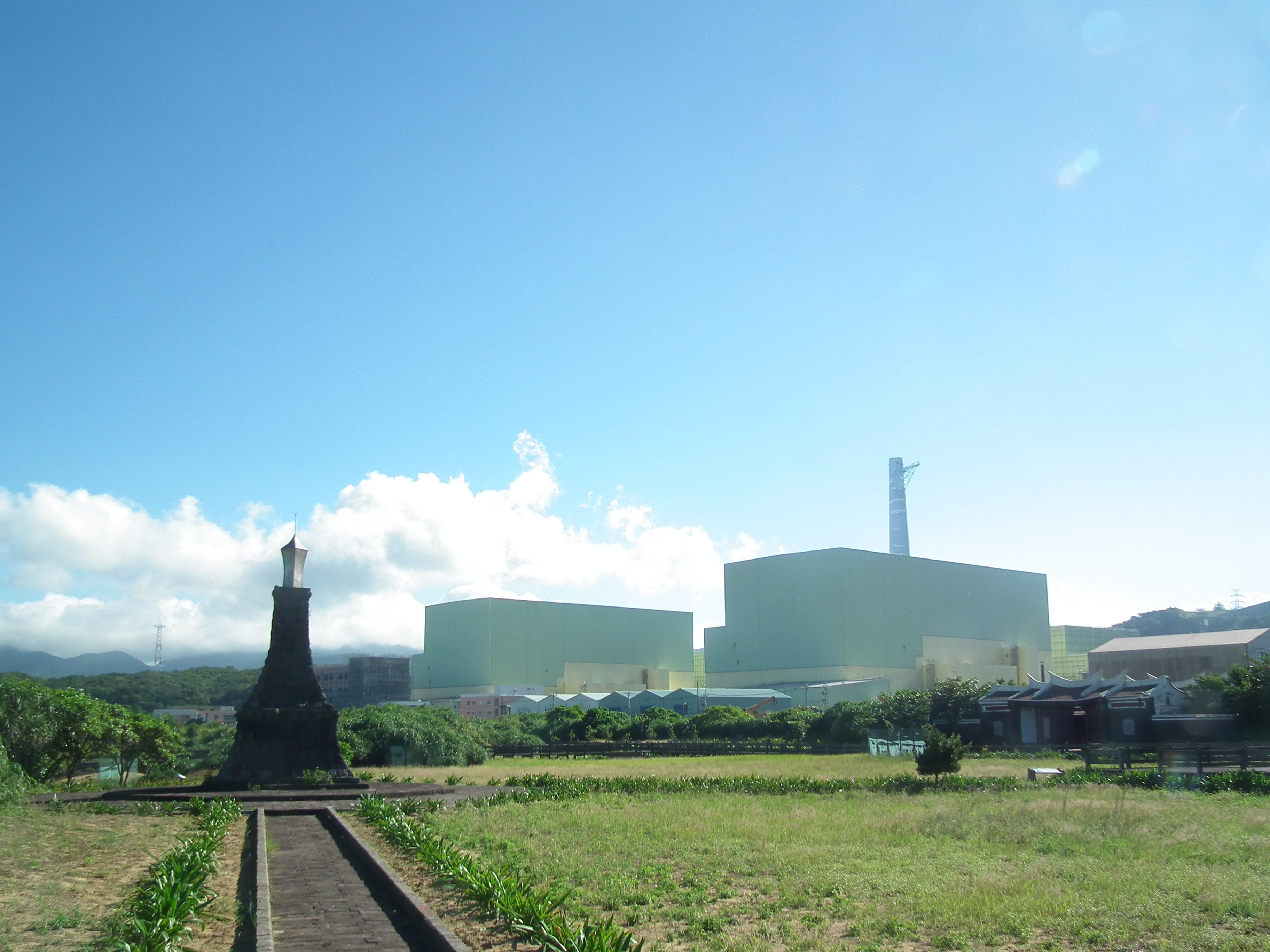
The ABWR was the first reactor ever certified under the NRC part 52 framework. As mentioned above, the modularization scheme was more flexible than the AP1000’s rigid modular architecture, which contributed significantly to field execution problems at Vogtle.
Toshiba’s withdrawal from the South Texas Project in 2018 represented a financial failure, not a technical one: unpromising market conditions and an inability to find investors after the shale gas revolution collapsed merchant power economics were the spoilers. Hitachi’s suspension of the Wylfa Newydd ABWR project in Wales in 2019, after it had completed the UK Generic Design Assessment in 2017 and spent roughly £2 billion on development, was due to a deficiency in the financing structure, and not the reactor design or its licensing record.
Does the US need competition in large reactor technologies?
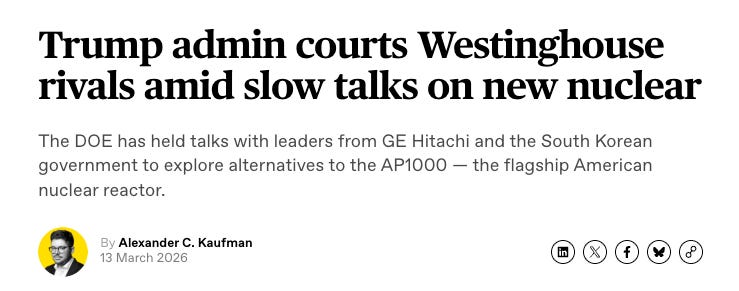
As mentioned in the introduction to this essay the U.S. Department of Energy has begun exploring alternatives to the AP1000. To the DOE, Westinghouse and its majority owner, the private equity firm Brookfield Asset Management, are moving too slowly. Utilities, for their part, want cost-overrun insurance that the current federal financing framework does not provide, and Westinghouse’s 2017 bankruptcy from Vogtle cost overruns is not a distant memory for anyone being asked to sign a new contract. Reporting by Alex Kaufman in March 2026 describes active engagement with GE Vernova Hitachi Nuclear Energy on potential deployment of the Advanced Boiling Water Reactor, alongside separate outreach to South Korean counterparts regarding the APR-1400.
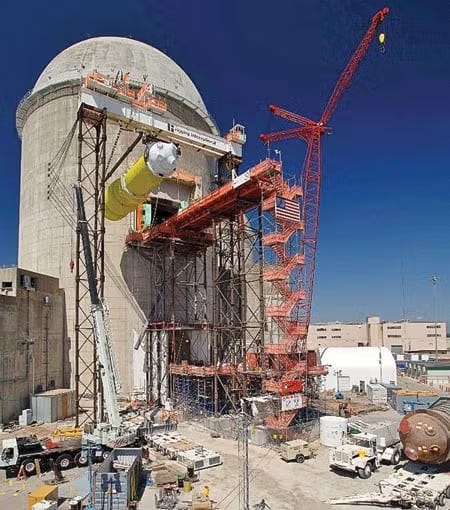
The case for competition has precedent within the US nuclear industry itself. In the 1990s and 2000s, steam generator replacement outages across the operating fleet initially required roughly 200 days. Over successive projects, that window was compressed to approximately less than 30 days.
The improvement came from repetition across a series of similar projects combined with direct competition between Bechtel and Steam Generator Technologies (SGT). Utilities could observe divergent performance in real time. Schedules could no longer be defended as fixed physical constraints. Each iteration forced contractors to explain delays in operational terms rather than attributing them to inherent complexity.
A similar dynamic is visible in current reactor construction programmes abroad. China maintains parallel large reactor supply chains, building Chinese AP1000 units alongside the Hualong One. This structure keeps cost and schedule performance legible across competing designs and organizations.
The technical basis for introducing competition in the United States already exists. The ABWR holds a completed design certification in the United States, with multiple reference units constructed and operated. The remaining constraint is institutional rather than technological.
Does GE Vernova have the capability to build both large and small modular reactors?
The most important constraint on an ABWR revival is organisational capacity. GE Vernova through GE Hitachi Nuclear Energy, which holds the ABWR certification, operates with roughly 1,400 to 1,500 employees globally and is already fully committed to first of a kind BWRX 300 deployments in Tennessee and Ontario.
Those programmes require sustained focus across licensing, supply chain formation, and site execution. A large reactor programme would introduce a parallel effort with distinct engineering, procurement, and regulatory demands.
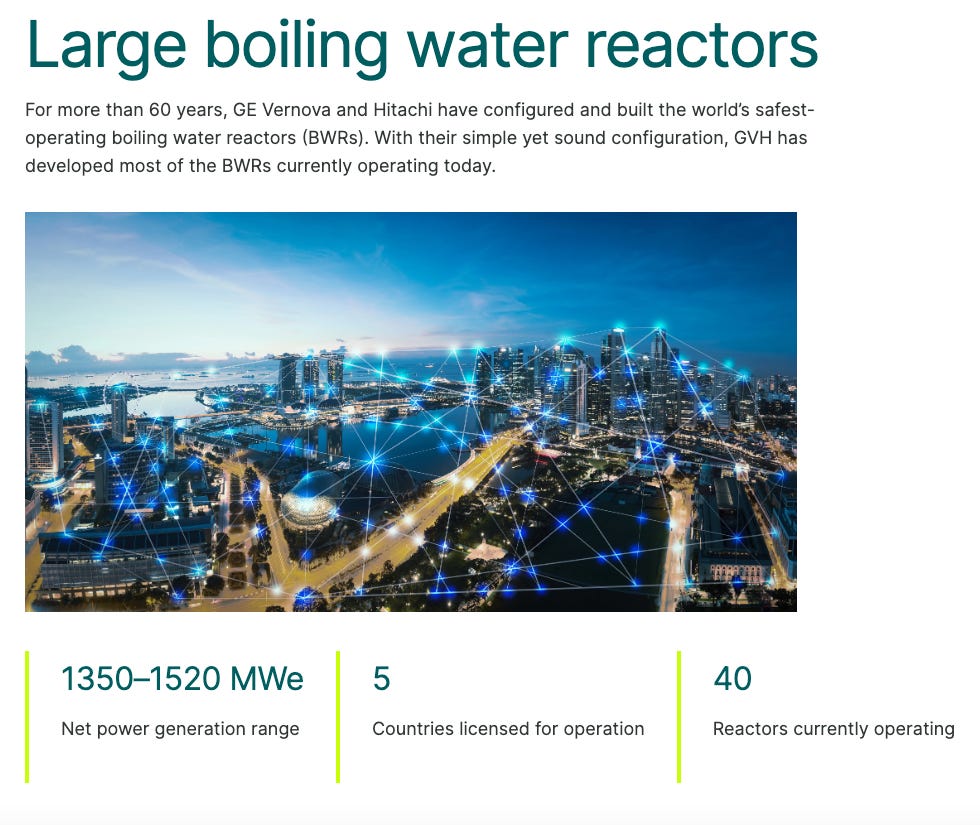
This reflects a structural shift. The organization that developed the ABWR and built the BWR5 and BWR6 fleet operated at larger scale within an industry that was building continuously. Today’s entity is smaller, more focused, and aligned around small modular reactor deployment, with capital and strategy directed toward the BWRX 300 and a reduced physical footprint following the sale of Vallecitos, GE’s historic BWR development site in California.
Alex Kaufman reports that the company has limited interest in reactivating the ABWR. An organisation of this size is unlikely to be able to sustain two separate reactor programmes simultaneously. The case for competition in reactor procurement remains, but it depends on whether any developer has the scale and execution capacity to deliver it.
Focusing on the wrong problems
The Western nuclear debate is hyperfixated on novel reactor designs as the solution to its decades-long struggle to build nuclear on budget and on schedule. The hope seems to be that a technological breakthrough or a novel concept will create a demonstrably superior reactor that will reverse decline and restore competitiveness with China.
Modularity, passive safety, novel coolants, TRISO fuel: these grab the headlines and drive funding cycles. Reactor design is no doubt a part of the equation. Modularity done well reduces field labour. Passive safety systems can eliminate backup diesel generators, reduce concrete and steel use and simplify cabling.
The ABWR however, illustrates that in nuclear the most consequential design gains often come from seemingly mundane construction and operations informed improvements rather than novelty. Nuclear technology iterates slowly and mature light and heavy water designs have taken 40+ years to arrive.
History however is clear that design alone, however well-conceived, is a relatively small portion of the ingredients that determine whether a reactor programme succeeds. Light water reactors despite significant design differences between PWRs and BWRs for instance have all converged on similar ranges of capacity factors, economic performance and construction schedules. There has not been a clear winner.
As the ABWR experience illustrates, what seems to really matter to successful deployment is design completion prior to construction and delivery by a competent project development organization, operating inside an industrial ecosystem that is active and staffed with experienced people at every level from project managers to tradespeople.
The West is currently disadvantaged after decades of relative inactivity within a broader shift in political economy towards deindustrialization and financialization. Supply chains have atrophied and experienced professionals are mostly retired.
As a result the Western nuclear renaissance, when it comes, will likely be a crawl before it learns to run again. Early projects will disappoint when measured against Japan’s record from the 1990s or China’s contemporary construction timelines. The central challenge of revival will involve sustaining political and financial commitment in spite of those disappointments while maintaining a laser focus on the lessons the ABWR experience has taught us.
Listen to the full conversation with James Krellenstein on the Decouple podcast.
Another good job technically. But once again you guys simply won't acknowledge teh crippling impact of an auto-genocidally misguided autocratic regulatory system, The UK could have had two ABWR's at Wylfa. Here's what happened around 2017.
https://jackdevanney.substack.com/p/alara-in-action-the-abwr-vents
We won't ahve anything close to should-nuclear until we replace that system.
Pass the Nucelar Reorganization Act.
The AP1000 is a fantastic reactor that suffered from a bad supply chain. The capacity factors at Vogtle and in China show that. The ABWR is a terrible reactor with a fantastic supply chain. The capacity factors in Japan show that.