

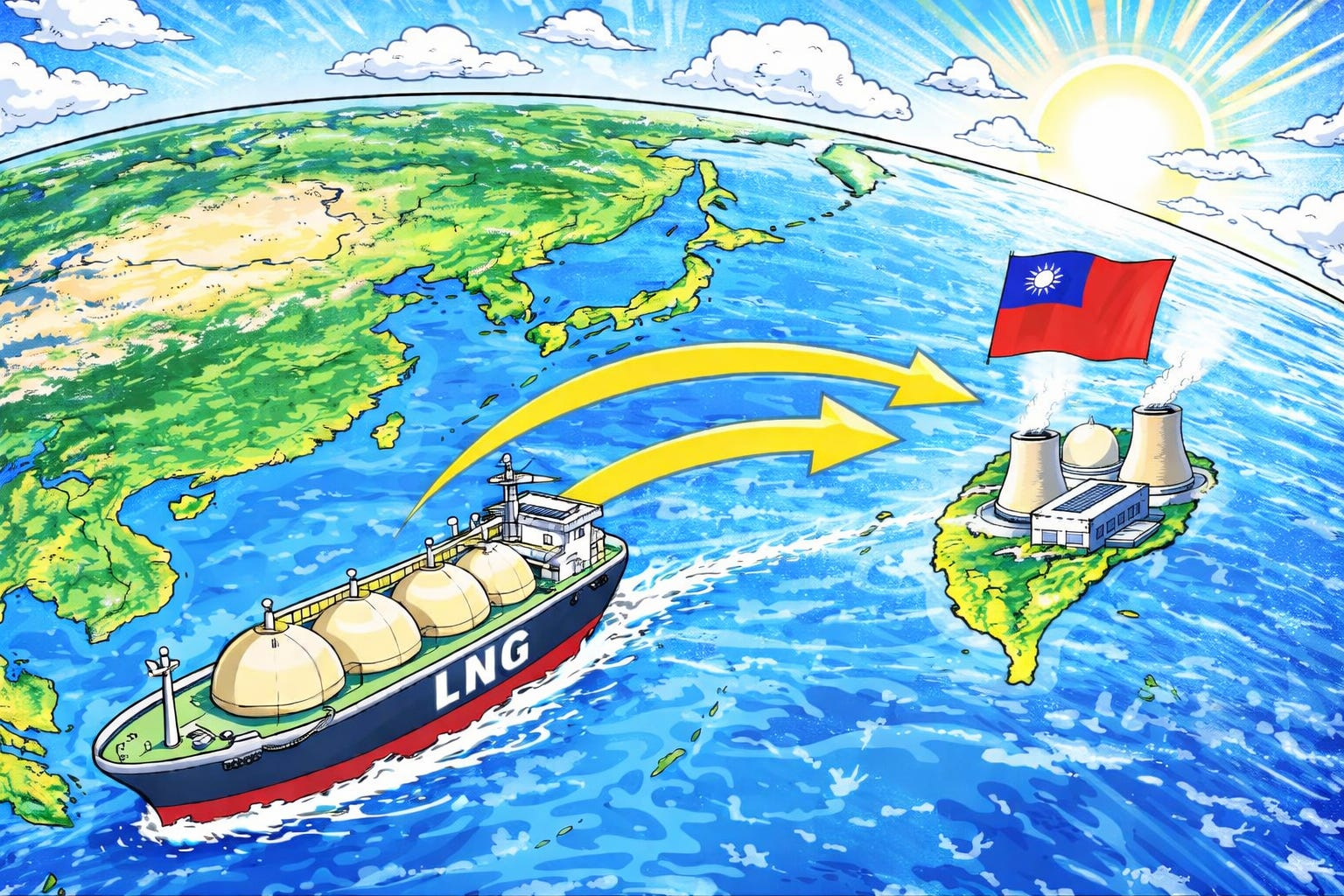
The energy crisis resulting from the War in Iran is bringing the catastrophic energy blindness of Taiwan’s political leadership into unforgiving focus.
Taiwan imports roughly 35% of its LNG from Qatar. LNG fuels nearly half of Taiwan’s grid after its political phaseout of nuclear power. The island maintains only about 11 days of LNG storage.
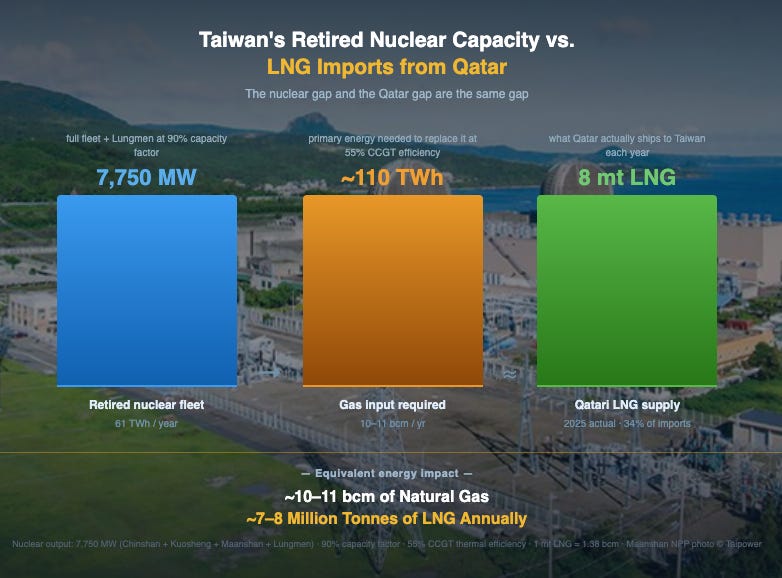
Had Taiwan kept its full nuclear fleet operating and commissioned Lungmen, its completed but never fuelled fourth nuclear plant, the country would today have roughly 7,750 MW of nuclear capacity producing about 61 TWh per year, covering around 21 percent of the grid.
Replacing that nuclear output with gas requires far more primary energy because Taiwan’s combined cycle gas turbines operate at roughly 55 percent thermal efficiency. Producing 61 TWh of electricity from gas therefore requires roughly 110 TWh of fuel input, equivalent to about 10 to 11 billion cubic metres of natural gas or roughly 7 to 8 million tonnes of LNG per year.
That volume is almost exactly the amount of LNG Taiwan currently imports from Qatar.
In other words, the nuclear fleet Taiwan shut down would have displaced essentially the entire Qatari supply stream.
Instead that capacity was retired and mothballed on political grounds and the gap was filled with gas.
In a fit of common sense, Taiwan held a referendum in August of 2025 on whether to restart the Ma’anshan nuclear plant, the island’s last operating reactor station, which had shut down in May after its forty year operating licence expired.
A clear majority of participating voters supported restarting the plant subject to regulatory approval and safety confirmation.
Taiwan’s referendum law, however, requires affirmative votes from at least one quarter of all eligible voters, roughly five million people. The referendum received about 4.3 million yes votes, leaving it below the legal threshold and keeping the plant offline, effectively confirming the continuation of Taiwan’s nuclear phaseout and LNG over dependence.
Taiwan depends almost entirely on above ground insulated LNG tanks at their import terminals. They function as a buffer designed for a world of uninterrupted deliveries rather than a strategic reserve designed to ride out a supply shock.
When a major node in the LNG system fails, there is no large fleet of idle ships ready to reroute, no spare liquefaction capacity waiting to fill the gap, and in Taiwan no underground storage that can stabilize supply while the market adjusts.
Taiwan’s nuclear shutdown therefore produced a structural vulnerability that is in the context of our current energy shock now impossible to ignore. The reactors that were closed would today be offsetting almost the entire volume of LNG Taiwan buys from Qatar.
There's never been a better time to restart Taiwan's nuclear fleet. Will Taiwan’s political class abandon their luxury beliefs and come to their senses?
Only time will tell.
The People's Republic of China is the strategic beneficiary of Taiwan unilaterally closing down their nuclear power plants. I would not be surprised to learn the Chinese developed means to implement Taiwan's nuclear closure which echo the methods that Putin employed to shut down Germany's nuclear power fleet for strategic advantage. CGNP has criticized the unnecessary German nuclear shutdown on the GreenNUKE Substack. https://greennuke.substack.com/
Chris, Please fix "Replacing that nuclear output with gas requires far more primary energy because Taiwan’s combined cycle gas turbines operate at roughly 55 percent thermal efficiency." The primary energy produced by a nuclear power plant is thermal energy, converted to electricity at about 33% efficiency. The CCGTs achieve 55% because they are hotter than the steam of a LWR, limited by achievable pressure.