

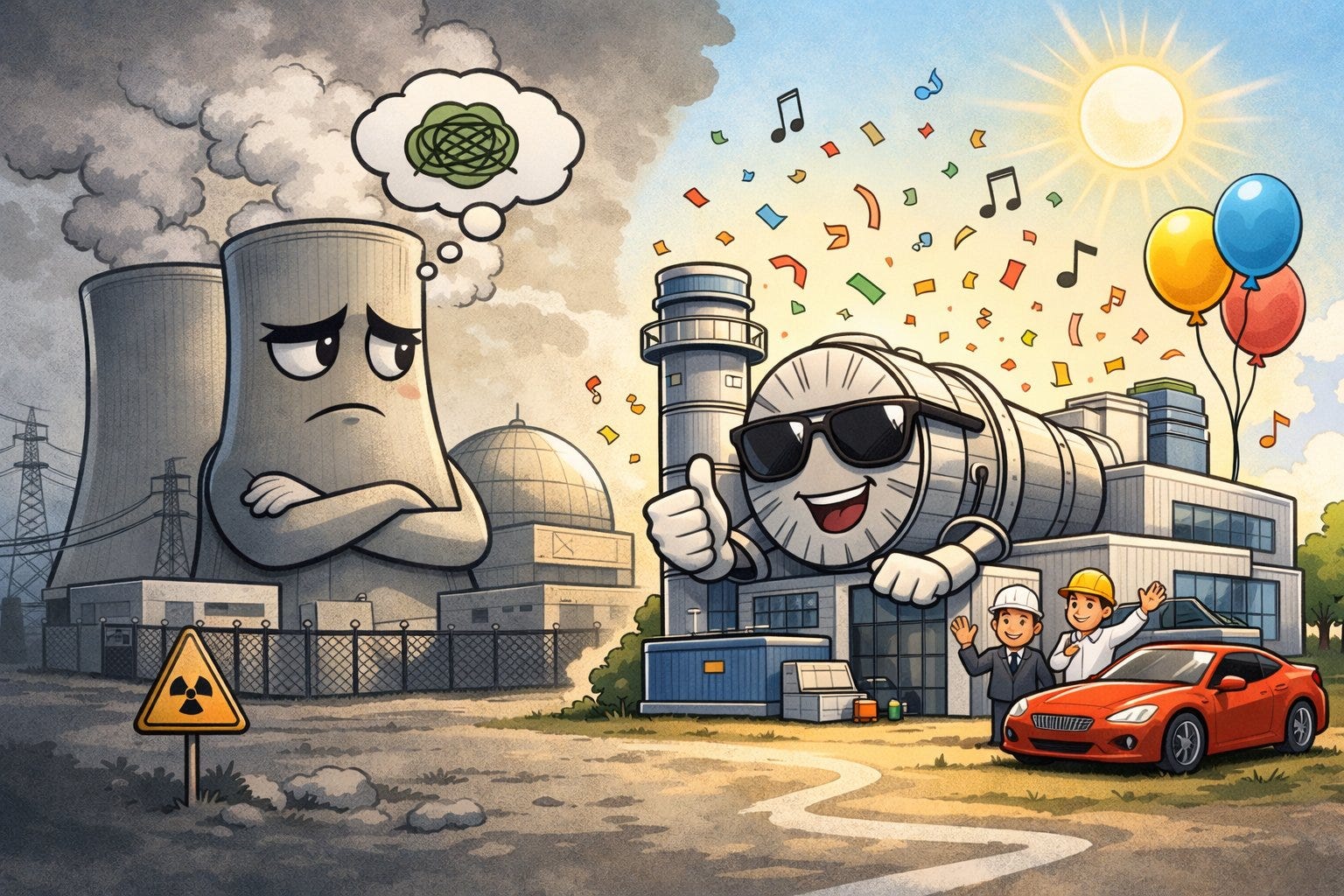
The SMR craze reflects a fundamental category error and combined cycle gas turbine envy. It tries to map the attributes of a CCGT plant onto nuclear, where the underlying cost structure and physical infrastructure is fundamentally different.
A CCGT plant is essentially a jet engine bolted to a heat recovery steam generator and a smaller steam turbine. The critical point is where the complexity sits. The gas turbine, which is the expensive and technically demanding component, is built in a factory, hot functionally tested and shipped to site as a finished machine.
Construction on site is largely installation, foundations, piping, electrical connection, using conventional materials and repeatable processes. That architecture shifts risk into manufacturing and compresses timelines. Rather than building the hardest part on site you are simply installing it in 24-36 months.
Nuclear does not behave this way. It can incorporate modular components, but the NSSS is only 25-40% of cost. The dominant cost drivers sit elsewhere. Civil works, excavation, basemat, containment, seismic qualification, remain site specific and labour intensive. Nuclear grade quality assurance, documentation, and inspection add another layer of fixed overhead. Safety systems with redundancy and independence are function driven, not size driven, so they do not shrink proportionally with output.
The nuclear steam supply system is not analogous to the gas turbine in a CCGT. It is not a fully integrated, factory proven machine that arrives ready to run. The plant comes together on site, under regulatory oversight, with integration, testing and certification happening during construction & commissioning.
This is why economies of scale are so strong in nuclear. Many of the costs do not scale linearly with power. When you reduce reactor size, you reduce output and revenue, while a large share of the cost base remains. Studies show that smaller reactors actually increase the relative share of on site construction because the civil works do not shrink in proportion to capacity.
The SMR thesis assumes nuclear can transition from a project to a product, capturing the modular, factory built economics of gas plants. The constraint is that the parts of nuclear that dominate cost remain stubbornly project based.
The envy is understandble. CCGTs are extraordinarily compelling. They are marvels of thermally efficiency, capital light, fast to deploy and supported by a global supply chain of standardized components. They are the most successful large scale power plants of the past decades.
It is only natural that nuclear developers would look at that model and attempt to emulate it but in so doing they are committing a grave category error, an error that is setting the western nuclear industry up for decade(s) of disappointment.
Some SMRs will get built but they will not replicate the CCGT promise. They will be mini versions of large reactors with mini revenues to pay off the significant inherent costs of nuclear power.
SMRs, Fusion and Grid-Scale Batteries. They will all be available in ten years. Just like in 2016, 2006, 1996…
Problem with that is basically you are condemning to death billions of people. We are already seeing the fragility of our 90% fossil fuel energy supply, to geopolitical events. While the ruling class has gambled everything on wind & solar, so far over $7T blown and they are up to 2.5% of World Primary energy. Can't even keep up with the growth of energy consumption, never mind replacing any fossil.
And with the Developing Nations legitimate aspirations to industrialize, which will require a further 5X increase in World primary energy.
Only nuclear energy is capable of supplying that level of energy, and fortunately it is quite capable of supplying that without significant environmental effects for a 100Myrs with just the accessible fission resources on Earth. Until the Sun consumes the Earth with fusion resources.
You ain't going to do that with the one-at-a-time build of big PWRs. The only way that is achievable is factory built, assembly line produced SMRs. And that would have been done 30yrs ago if not for regulatory impediments. The regulators are telling us that it is better to kill millions of people than allow nuclear to rapidly grow but with rational safety constraints. Including the only rational way to evaluate safety which is Comparative Risk Assessment.
What the regulators can't figure out is you get safety by building in quantity, incrementally improve, mass produce the apparatus that can monitor & control reactors with far more sophistication than anything done, anywhere right now. With A.I. monitoring and digital control systems it is virtually impossible to have any serious accident. What a modern automobile, like a Tesla, does is far, far beyond anything a nuclear reactor must do. Tesla's work because of the way they are built. As Musk frequently states, designing and building the machine is easy, building the factory to produce the machine in quantity is what is difficult.
A Starship launch system makes any nuclear reactor on Earth look like a child's toy. But Musk from the very start designed it with mass production in mind. A thousand or more a year from one factory. If the NRC was regulating the rocket industry, Musk would be still trying to get a small rocket to orbit.
This is the type of reactor we will need in order to survive into the next century:
Energy Future Unveiled! THORIUM Molten Salt Reactors, Copenhagen Atomics:
https://www.youtube.com/watch?v=27IntvWo4mo
This guy gives the best description of what should happen with Nuclear:
Energy Transition: Nuclear SMRs vs Renewables, Energy Transition Crisis:
https://www.youtube.com/watch?v=yBF2fGUO5cQ
"This video explains how advanced small modular nuclear reactor (SMR) technology can be used to completely replace all of the energy we now derive from fossil fuels, for less investment than what’s already been spent on renewable energy in the last two decades alone."