

When the Northwest Sturgeon Refinery was finally ready to process bitumen after years of engineering and construction, a mission-critical component in the $12 billion facility failed after only 40 hours.
The component was a burner buried inside the refinery’s gasifier, where residual heavy hydrocarbons, oxygen and water are reacted at temperatures around 1,100 degrees Celsius to produce the hydrogen required by the refining process. This part, supplied by the German original equipment manufacturer, was supposed to last thousands of hours.
A refinery could not economically operate around replacing a mission-critical component every two days. Without the gasifier, there was no hydrogen. Without hydrogen, the refinery could run on lighter feedstocks like synthetic crude but could not economically perform the job for which it had been built: converting Alberta bitumen into high-value products.
“You just wasted twelve billion dollars,” is how Ian McGregor remembers the stakes.
McGregor is an Alberta mechanical engineer, serial entrepreneur and industrial project developer who conceived the Northwest Sturgeon Refinery and helped develop the Alberta Carbon Trunk Line. When I visited him this summer at his Canadian Museum of Making in the foothills west of Calgary, we ended up talking about Sturgeon and the lessons it holds for nuclear power, an industry once again learning how to build large things.
Bitumen In, Diesel Out
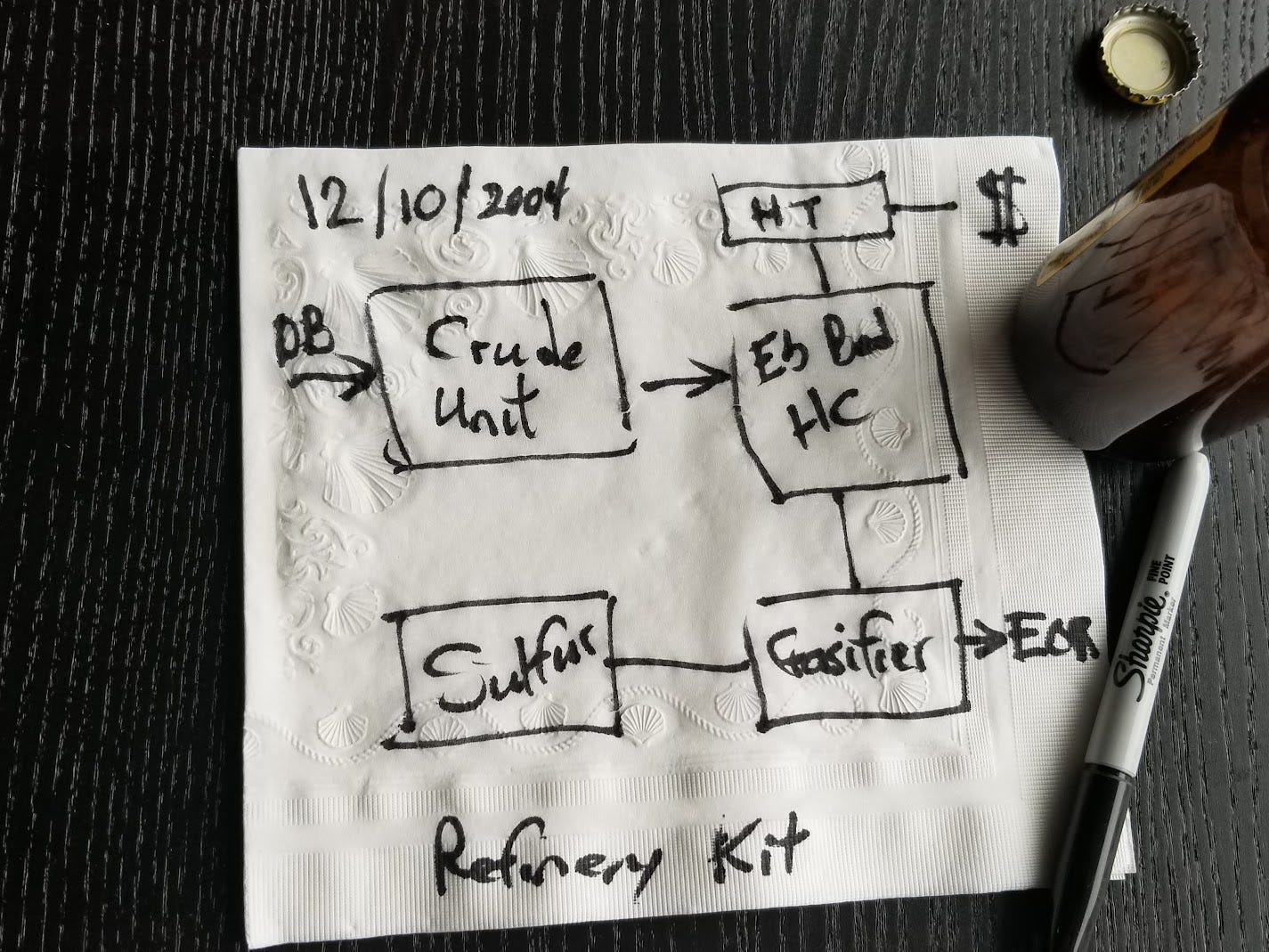
Ian’s refinery began as four boxes drawn on a napkin to address one of Alberta’s longstanding goals: economic diversification. Alberta possesses one of the world’s largest petroleum resources but exports most of it as a raw material, bitumen.
At ambient temperatures, it is too viscous to flow through a pipeline and must first be blended with a much lighter hydrocarbon, called a diluent, at a near 3:1 ratio.
Thus, a relatively low-value raw material is made substantially larger in volume so it can be shipped thousands of kilometres to somebody else’s refinery, where the diluent is removed, and the high-value processing occurs.
McGregor’s napkin solution was essentially bitumen in and low-sulphur diesel out.
The refinery he eventually built was considerably more complicated. Rather than use a conventional coker, which rejects the heaviest fraction of the bitumen barrel as petroleum coke, Sturgeon was designed around hydrogen addition, breaking large hydrocarbon molecules apart and adding hydrogen to produce lighter products.
The hydrogen itself would be made in the gasifier from the bottom of the bitumen barrel rather than from natural gas. This also produced a concentrated stream of CO2 which could be captured and sent down the associated Alberta Carbon Trunk Line for geological storage and enhanced oil recovery. The refinery was designed to capture around 4,000 tonnes of CO2 per day.
Seven Thousand Pieces of Equipment
Ian’s four boxes were becoming a fairly complicated machine.
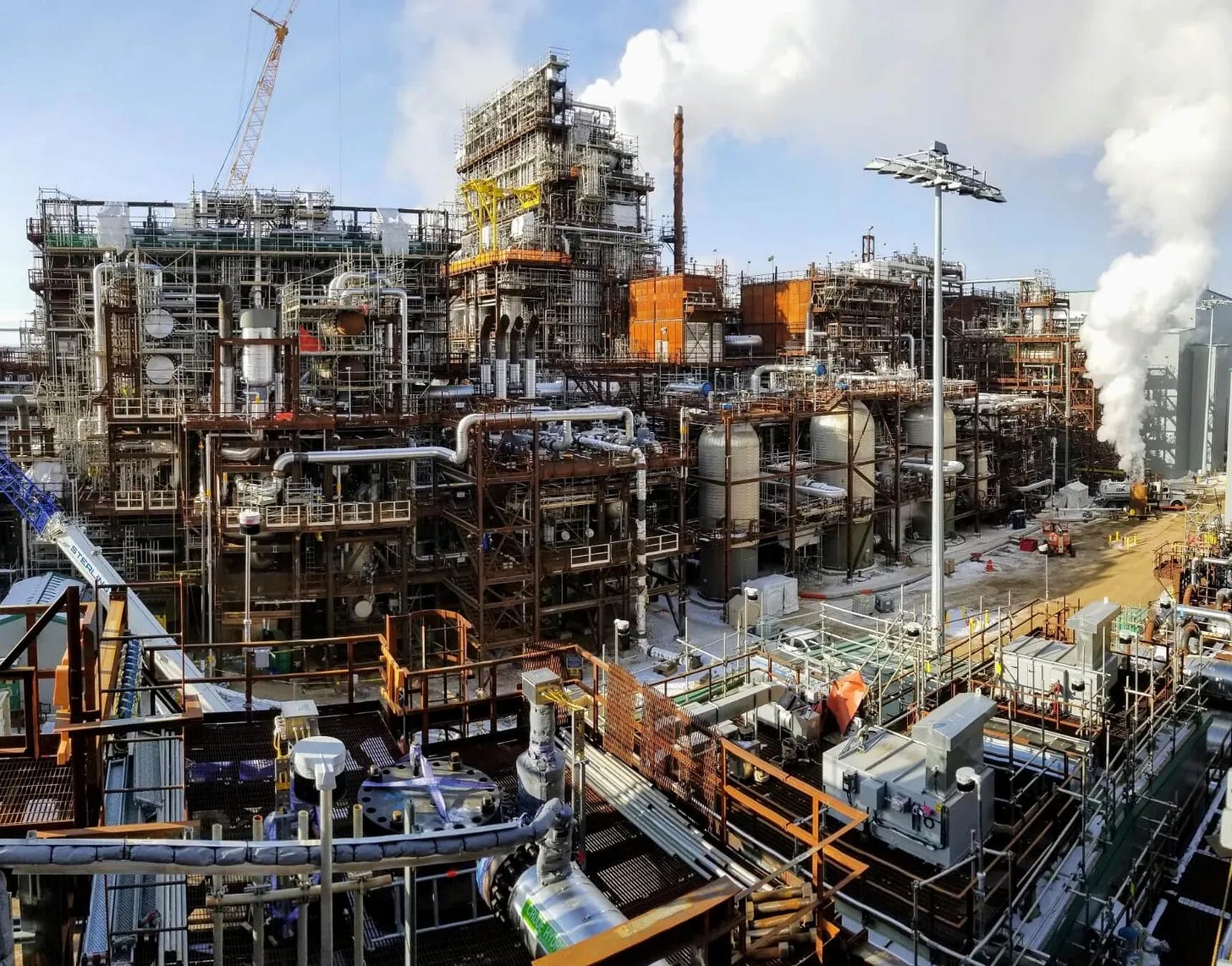
McGregor estimates that roughly 100 million person-hours went into the refinery between fabrication shops and field construction. Some 1,434 large modules were assembled at site, many around 20 feet wide, 20 feet high and more than 100 feet long.
His favourite statistic is that the refinery contained roughly 7,000 individual pieces of equipment costing more than $100,000 each.
This helps explain why megaproject estimates have a habit of deteriorating as construction proceeds.
A conceptual design can be surprisingly compact. Engineering gradually reveals the thousands of pumps, valves, heat exchangers, electrical systems, control systems, structural supports, pipes and instruments required to make the boxes on a process diagram become a functioning industrial plant.
On Sturgeon, McGregor estimates around $100 million had been spent by the time the first serious project cost estimate was assembled. That sounds like an extraordinary amount of money. It was in fact nowhere near enough. The final engineering bill was closer to $1 billion.
Finishing all of that engineering before construction would have substantially improved project definition, but it would also have required investors to risk a billion dollars before knowing whether the project would ever proceed. McGregor’s experience was therefore similar to that of many large industrial projects: engineering continued while procurement and construction were already underway.
That creates a secondory problem. A module may be scheduled to leave a fabrication shop while a large heat exchanger destined for its interior is still somewhere in Italy. Thousands of workers at site are waiting for the module and delaying shipment can disrupt an entire construction sequence. So the module is shipped incomplete.
The heat exchanger, however, arrives three months later. By then the surrounding structure may be eight storeys high and the project team is left figuring out how to install equipment in a space that was intended to receive it when the module was still lying on the shop floor.
Looking back, McGregor thinks the expediting department may have been one of the most important organizations on the entire project.
Making Your Own Weather
Sturgeon employed around 7,000 people at peak construction. There were nowhere near enough electricians, pipefitters and other skilled trades sitting idle around Edmonton waiting for a call.
Workers were drawn from the neighbouring provinces of Saskatchewan, British Columbia, Manitoba and later Ontario and Newfoundland. They arrived capable of doing the work but unfamiliar with the site, the systems and the teams around them. By the time a worker became fully productive, the particular phase of construction that required him might already be approaching completion.
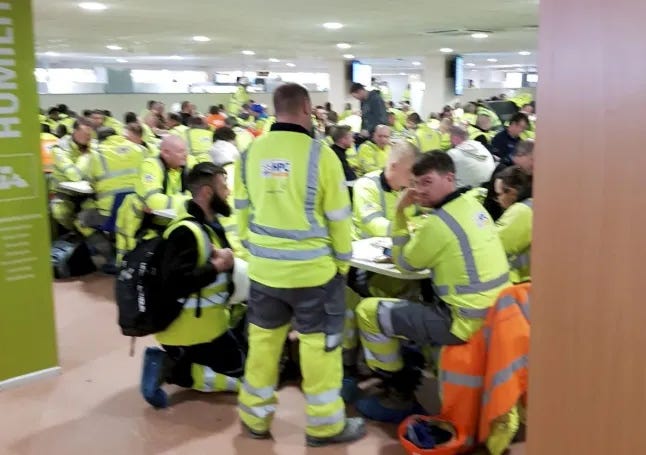
The sheer scale of a megaproject, in McGregor words “made its own weather,” by altering the labour market assumptions on which its original estimate had been based.
The same problem existed inside the organization managing it. A megaproject creates a temporary institution composed largely of people who have never worked together and then asks them to execute one of the most complicated activities undertaken by an industrial economy.
Systems for cost control, procurement, engineering and construction management were being developed at the same time that the project was advancing. McGregor had spent his career building industrial businesses, however, the major engineering, procurement and construction contractors across the table had decades of experience negotiating contracts and were very good at protecting their margins.
The Edmonton Manhattan Project
The German gasification technology Sturgeon purchased came from one of the most experienced suppliers in the world. Germany’s historical expertise was based on its struggles in the Second World War to alleviate chronic shortages of petroleum with coal-based synthetic fuels at industrial scale. Its technological lineage stretched back many decades and the process itself was well established.
Although rated for 2000 hours of service the burners failed in just forty. The refinery went off line and interest during construction kept accumulating at a rate of roughly one million dollars per day.
McGregor gathered half a dozen of the smartest engineers and technical specialists he knew and decided they would solve the problem themselves.
The effort lasted 279 days.
The team spent around $12 million running finite element analysis and computational fluid dynamics models, working through heat transfer, fluid velocities, materials and geometry.
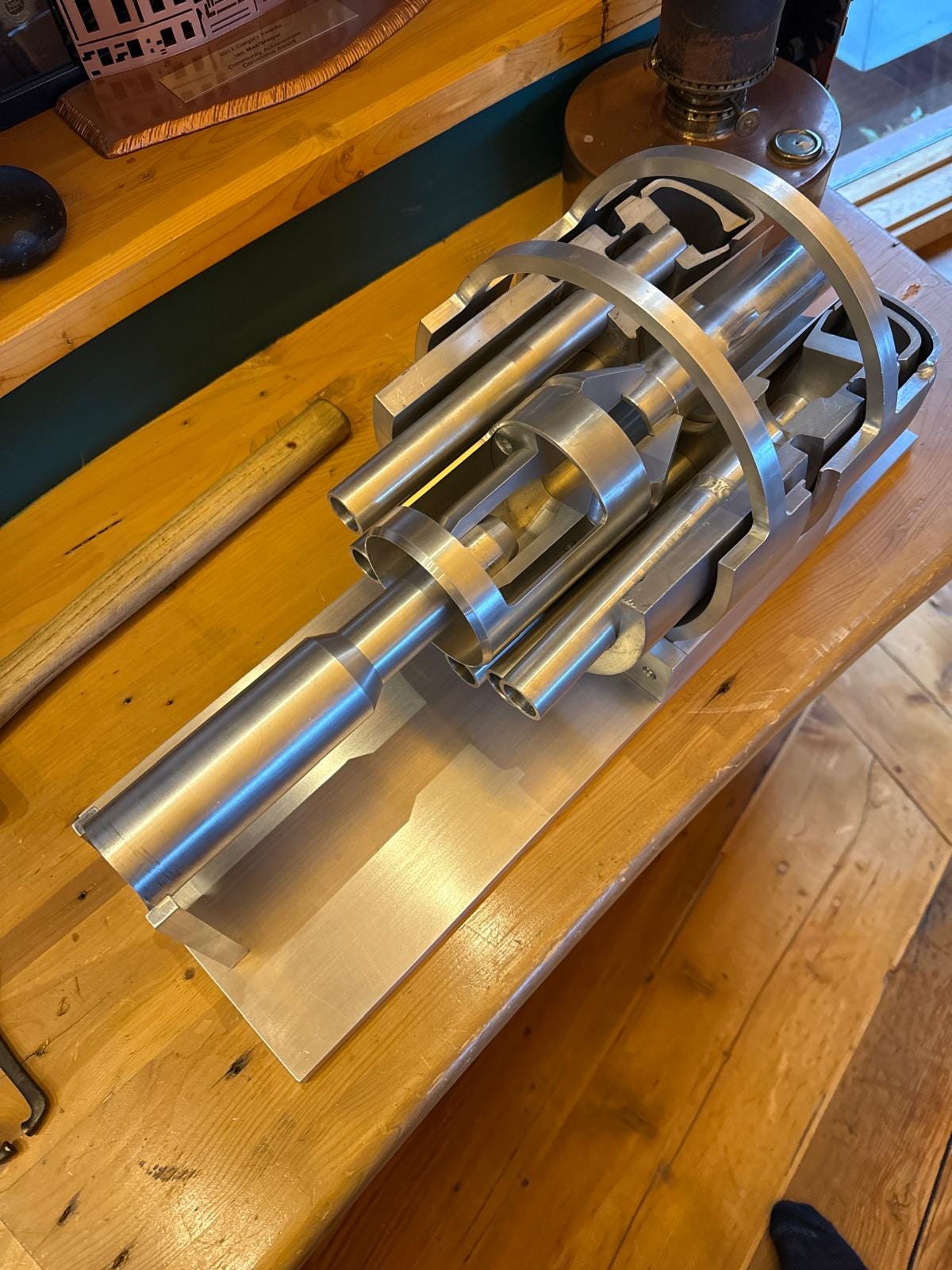
The burner contained a narrow water jacket which had to keep cooling water moving at roughly 80 metres per second in a wafer thin hydraulic window: too slow and heat transfer failed; too fast and pressure losses risked local boiling. The geometry controlling that flow had to be held to around one tenth of a millimetre.
Then the engineers confronted the inconvenient reality that their drawings had to be manufactured. The final welding assembly caused roughly six millimetres of shrinkage.
McGregor brought in an experienced engineer/welder named Brett Jackson who he describes as the Leonardo da Vinci of his trade. During their twice daily meetings after the computer specialists finished presenting their latest design McGregor would look over and ask whether Brett could actually build it. Often the answer was no, and the engineers went back to work.

Eventually Brett developed a welding sequence that anticipated the distortion, alternating where heat was applied and gradually bringing the finished component into tolerance.
The lesson is familiar across advanced industrial technologies. Drawings, computer models and specifications capture an enormous amount of knowledge, but never all of it. The remainder lives as esoteric knowledge in experienced people who can sense for example how metal behaves under a welding torch.
The redesigned version of the part that failed in 40 yours now runs for 8,000 to 10,000 hours.
The Long Tail
Sturgeon became an irresistible target for the media during its troubled construction and commissioning. The project ran far over its original budget and the burner failures arrived after most of the capital had already been spent. McGregor turned off his hearing aids and kept working.
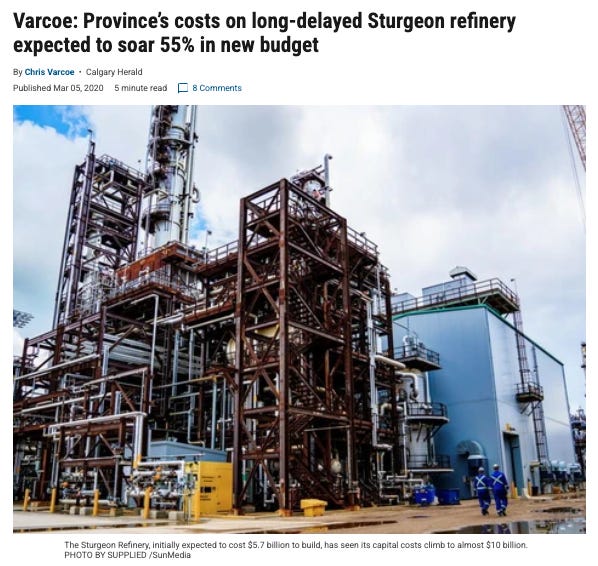
Today the refinery is operated by Canadian Natural Resources, one of the most experienced oil sands operators in the world. McGregor sold his interest in 2021 and no longer has access to its detailed operating data, but says that over the last five years the facility has matured into a highly productive asset running above its original design capacity.
With 7,000 major pieces of equipment, initial commissioning does not reveal the full capacity of a plant. Operators continuously learn through failures, maintenance outages, modifications and successive turnarounds.
That creates a peculiar mismatch between the economics of megaprojects and the institutions expected to build them. A refinery, railway or nuclear plant can operate for many decades. Its worst financial years are often concentrated near the beginning, when capital is being spent, interest is accumulating and the plant is producing little or nothing.
Those years also happen to overlap almost perfectly with the career horizon of the executive asked to approve it.
The CEO who is asked to spend several hundred million dollars advancing a project toward a final investment decision is aware that the worst problems will probably arrive four or five years from now. This while approaching the end of their tenure with a substantial portion of their compensation still tied to the company’s performance. There are safer ways to finish a career.
Discounted cash flow adds a second bias against the long-lived asset. At a 10 percent discount rate, revenues several decades into the future contribute very little to present value even when the physical plant may still have generations of useful life ahead of it.
The institution with the longest time horizon is ultimately the state. This is one reason railways, canals, power systems and other infrastructure central to national development have so often involved governments as financiers, customers, guarantors or owners. Their economics unfold over periods much longer than a corporate planning cycle.
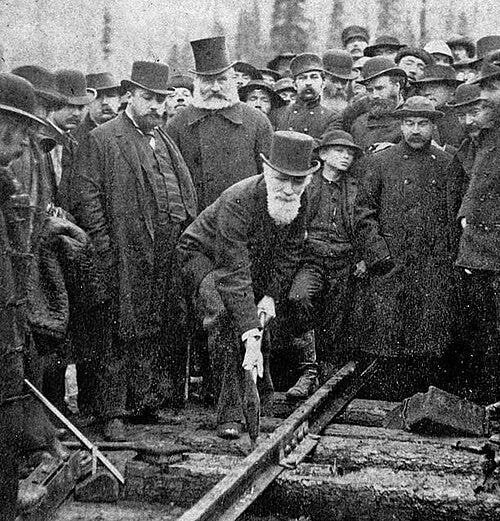
The Canadian Pacific Railway, for example, was initially expected to cost roughly $100 million. By the time the last spike was driven in 1885, the main line and its equipment had cost closer to $150 million, repeatedly forcing Ottawa to rescue a company whose failure had become politically and economically unthinkable.
Railway politics had already brought down one Canadian government in the Pacific Scandal of 1873. A century and a half later, on the eve of its merger with Kansas City Southern, CP was worth roughly US$50 billion, and Canada itself was scarcely imaginable without the railway.
Back to Nuclear
Canada is returning to nuclear construction after a long pause. Ontario is building the first BWRX-300 at Darlington while simultaneously preparing for large reactor projects and continuing the refurbishment of much of its existing CANDU fleet.
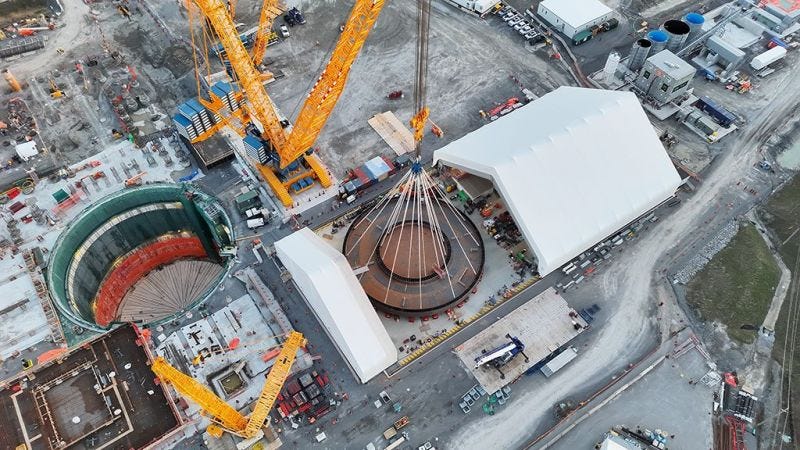
The nuclear industry already has spent insufficient time debating first-of-a-kind technology risk. McGregor’s experience suggests the category should be expanded further.
A project organization can also be first of a kind. So can a supply chain that has forgotten how to manufacture a component, a construction workforce assembled for the first time or an owner organization without recent experience delivering a greenfield megaproject.
None of this precludes large projects. Sturgeon was built and operates beyond expectations. The near catastrophe of its failed gasifier burners was resolved in an Edmonton machine shop by a combination of advanced computer modelling, experienced engineers and an unusually talented welder.

Canada once possessed a wealth of people with this kind of experience across mining, pipelines, refining, hydroelectricity and nuclear power. Many are now retired or approaching the end of their careers.
The next generation will acquire the same knowledge in much the same way the previous one did: by building things, discovering that some of their assumptions were wrong, fixing them and building again.
Megaprojects will continue to make their own weather. The countries capable of enduring the storm will be the ones that will learn how to build them again.
Like this post to mega-help the Decouple project
An interesting follow up question: what would it cost to duiplicate the Sturgeon refinery now?
And how much should be changed to optimize for what they now know, but how much cost/risk would that impose on the project?;
Great article, thanks! I'm running through this on a smaller scale myself, and we're due to spend almost 10% of budget just to get to the estimations & costings stage with the most awkward engineering done. If the estimation doesn't work, the remaining 90% might not happen and I'm lining us up to engage suppliers for quoting the big stuff in 6 or 7 weeks, while we run engineering in parallel. Fun times!