

“But he hasn’t got anything on!” said a little child.
Hans Christian Andersen, The Emperor’s New Clothes (1837)
In August 2026, American advanced nuclear startup Oklo celebrated taking its Groves-1 reactor from groundbreaking to first criticality in less than a year, presenting the achievement as evidence that nuclear projects could be delivered more rapidly than many had thought possible.[1]
Oklo described Groves as a “commercial-scale facility,” referring to its siting, construction and commissioning experience, while CEO Jacob DeWitte declared that this experience was “fully translatable to future commercial deployments.” The Department of Energy joined the celebrations, presenting Groves as another milestone in America’s nuclear comeback.[1]
The celebrations extended well beyond the usual corporate press releases and government announcements. In September, DeWitte appeared on The Best One Yet, a popular business podcast recorded at Groves, where the hosts acknowledged that Oklo paid for their travel to Texas and sponsored the episode.[2]
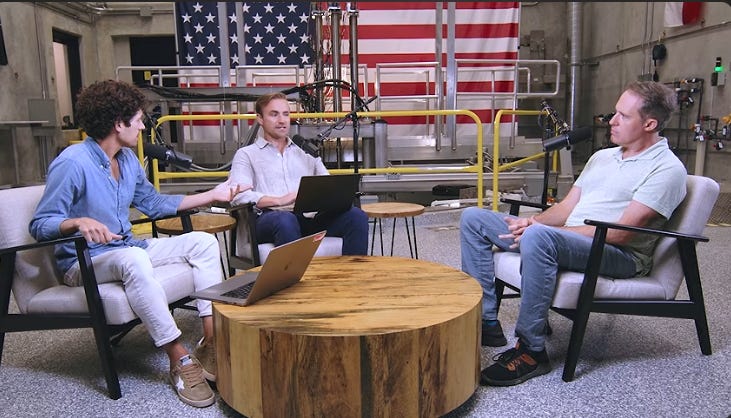
Describing Oklo as the “Lululemon of Nuclear” and its technology as “tiny, tidy, and sexy,” the program celebrated the company’s vision of nuclear-powered company towns and cancer-fighting isotopes. Its promotional material promised a nuclear breakthrough worthy of a second Oppenheimer movie.[2]
Behind the excitement was Oklo’s ambition to leverage its experience with Groves into commercial medical isotope production, establishing a business that “generates reliable revenue and supports the continuing development of the entire business.”[3] Yet medical isotope production is a notoriously unforgiving business, in which even producers with access to publicly funded reactors and fuel have struggled to turn a profit.
Commercial isotope production, however, remains a distant prospect for Groves-1. Oklo’s July announcement described it as a low-power test reactor without quantifying what “low-power” meant.[1] While the reactor may incorporate hardware designed for substantially higher power levels, the Department of Energy’s original environmental determination set its maximum operating power at just 100 watts, an incandescent lightbulb’s worth of thermal power.[4]
The spectacle of a sponsored podcast celebrating a new nuclear age beside a zero-power critical assembly would be funny if the financial stakes weren’t so high. For a company commanding a multibillion-dollar valuation despite generating just $3 million in revenue over the first nine months of 2026, promoting modest technical achievements as evidence of imminent commercial success has considerable financial value.[3]
Publicly traded nuclear startups have reason to exercise caution in their promotional claims. Fellow SMR developer NuScale already faces securities class actions alleging that it overstated its commercial prospects and competitive advantages.[5]

A Potemkin Village Reactor?
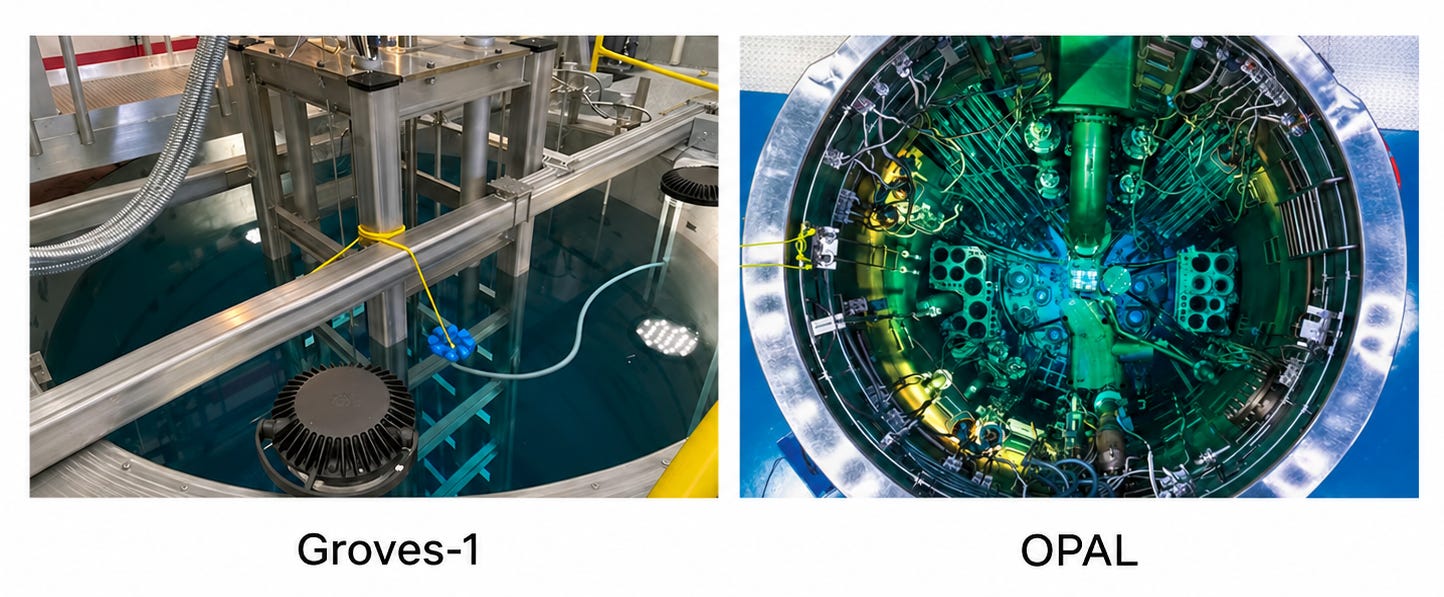
Groves-1’s five fuel assemblies use commercially available Framatome uranium dioxide fuel, while its unpressurized, water-cooled pool configuration has precedents dating back more than half a century.[4] Groves draws on the 15 MW thermal VIPR design developed by Atomic Alchemy, which Oklo acquired in February 2025 in a deal announced at US$25 million. While the American Nuclear Society attributes that power rating to Groves itself, Oklo has clarified that its description of the facility as “full-scale” does not refer to its power or isotope production capacity. What additional engineering and equipment would be required to operate Groves at 15 MW, 150,000 times the original DOE power limit, remains unclear.[4][6]
Remarkably, Oklo’s original project proposal envisaged just 100 hours of operation, no refuelling, and shutdown by the end of 2026, followed by defuelling, dismantling the facility, and restoring the site to substantially its original condition. The DOE repeatedly cited the reactor’s low power and brief operating lifetime in granting the project a categorical exclusion from further environmental review.[4]
Why build a 4,600-square-foot facility for a zero-power critical assembly? Whatever its longer-term experimental utility, Groves established a visible industrial presence in a state that had earmarked US$350 million to attract advanced nuclear development, while providing a photogenic showcase for investors. Oklo has since announced clearance for “unrestricted operations,” although it remains unclear whether the original power limit and decommissioning plans have been superseded.[6]
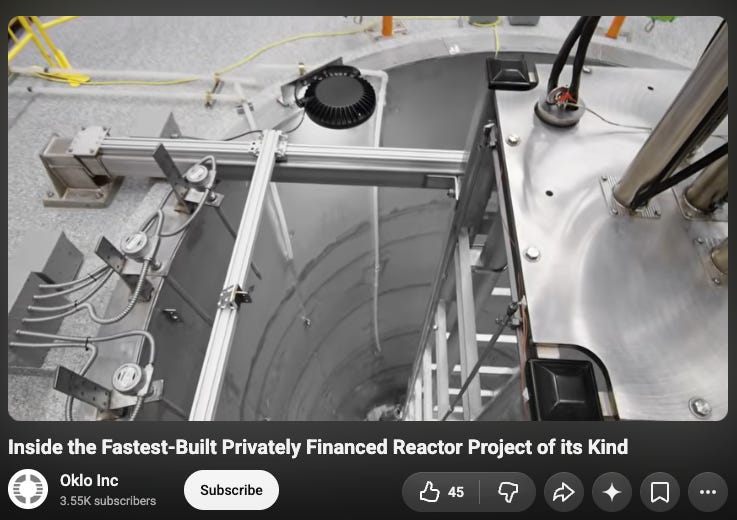
Oklo deserves credit for constructing and commissioning a nuclear facility on private land in less than a year under the Trump administration’s accelerated DOE authorization process.[1] But regulatory reform is arguably the easiest obstacle facing America’s nuclear renaissance. Regulations can be rewritten with a stroke of the pen; rebuilding an atrophied supply chain, replenishing a depleted engineering and skilled trades workforce, and recovering the industrial capacity to deliver nuclear megaprojects require years of painstaking work.
Like the microreactor developers achieving zero-power criticality under the DOE’s Reactor Pilot Program, Oklo has reached an important but relatively straightforward engineering milestone. Just as commercially productive power reactors require complex power conversion equipment and extensive supporting systems, commercial isotope reactors require target irradiation and retrieval systems, heavily shielded hot cells and sophisticated radiochemical processing infrastructure. By Oklo’s own account, it will add these capabilities in its subsequent Groves-2 Forge project.[7]
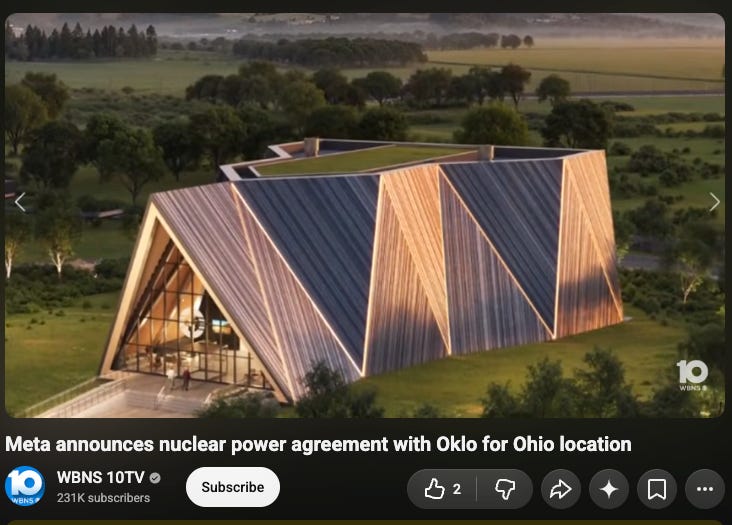
Much of Oklo’s extraordinary valuation rests on its proposed Aurora sodium-cooled fast reactor and agreements with prospective customers, including a nonbinding 12 GW deal with data-centre operator Switch through 2044 and plans to supply Meta with 1.2 GW beginning as early as 2030.[8]
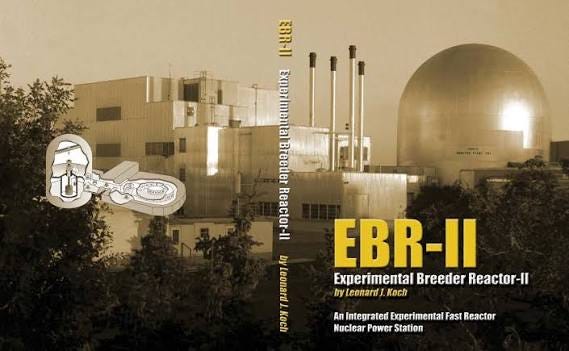
Transforming the technologies demonstrated by EBR-II more than half a century ago into a modern, economically competitive power plant presents formidable engineering challenges: qualifying and manufacturing HALEU metallic fuel, demonstrating materials performance under fast-neutron irradiation, and engineering reliable liquid-metal heat transport while managing sodium’s flammability and violent reactivity with water. Spent-fuel reprocessing and recycling present further challenges to Oklo’s longer-term business strategy.[9] For all the fanfare, Groves has addressed none of these challenges, and its conventional pool-type design demonstrates no fundamental innovation in reactor technology.
The Cruel Economics of Medical Isotope Irradiation
In its November 2024 shareholder letter, Oklo estimated the medical radioisotope market at US$55.7 billion by 2026. Remarkably, its cited source describes a Chinese government target for the economic output of its entire nuclear technology applications industry, encompassing agricultural breeding, food processing and security equipment.[10]
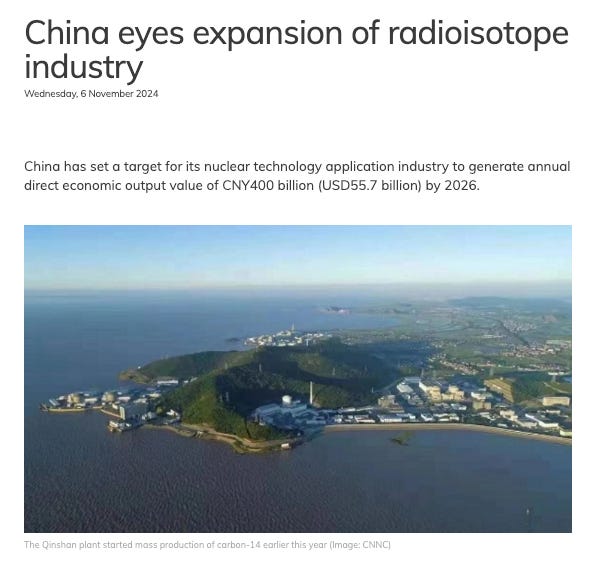
In a press release issued the same day, Oklo attributed the identical figure to market research firm Research Nester, whose underlying estimate could not be independently verified.[10] A 2026 European Commission-sponsored study estimates the upstream medical radiochemical supply market, the segment of the nuclear medicine industry Oklo proposes to enter, at approximately US$1.6 billion or more by 2028, roughly one-thirty-fifth of Oklo’s 2024 headline figure.[11]
Oklo’s proposed Groves-2 Forge, a separate facility building on the experience gained with Groves-1, will integrate reactor irradiation with shielded hot cells for isotope separation, purification and packaging, initially targeting lutetium-177 for cancer treatment. [6][7]
The infrastructure required to handle intensely radioactive materials is formidable. Bruce Power’s recently completed hot cell, designed merely to remove irradiated targets from their carriers, contains more than 90 tonnes of concrete, a seven-tonne personnel door and an enormous lead-glass viewing window.[12] Illustrative of the infrastructure challenges facing Oklo’s broader fuel recycling ambitions, Chalk River’s Advanced Nuclear Materials Research Centre, incorporating heavily shielded hot cells and remote-handling equipment, is now projected to cost C$1.025 billion, nearly triple its 2018 estimate.[13]
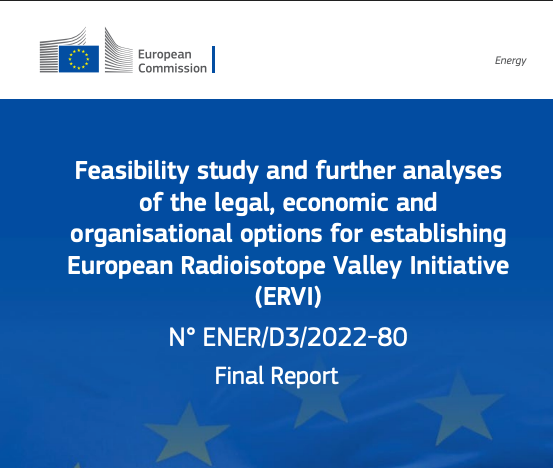
The European Commission study illustrates the economics of the medical isotope value chain for a typical ready-to-use lutetium-177-based radiotherapeutic drug. Enriched target material accounts for just 2% of its selling price, reactor irradiation another 3%, and radiochemical processing adds a further 5%. The remaining 90% lies downstream in pharmaceutical manufacturing and commercialization.[11]
The same European Commission study identifies isotope production in CANDU power reactors as a potential threat to the economic viability of dedicated research reactors, while recognizing their continuing importance to isotope supply.[11] Bruce Power has commercially produced lutetium-177 since 2022, exploiting CANDU’s exceptional neutron economy and ability to insert and retrieve irradiation targets at power, while sharing infrastructure, personnel and security costs with its 6.5 GW electricity business.[14] With the cost of the reactor and its fuel covered by electricity sales, the neutrons used for isotope production are free.
Even with access to publicly funded research reactors, commercial isotope producers have struggled. In 2018, NorthStar Medical Radioisotopes began domestic production of molybdenum-99, the precursor to technetium-99m, the world’s most widely used diagnostic medical isotope. Despite access to the University of Missouri’s existing research reactor and US$109 million in federal cost-sharing awards for its molybdenum-99 program, NorthStar abandoned production in 2023, citing rising costs and competition from government-subsidized foreign producers.[15]
Oklo, by contrast, must compete against producers whose neutrons are effectively subsidized while recovering the full capital, fuel and operating costs of its dedicated facilities. Australia’s 20 MW thermal OPAL, one of the world’s most heavily utilized multipurpose research reactors, supports ANSTO’s established isotope enterprise, which generated approximately AUD 60 million in radioisotope sales in 2024–25.[16][17] Matching this achievement at a generous hypothetical 30% net margin would yield Oklo AUD 18 million in annual profit, a modest sum in the context of its US$4.7 billion market capitalization.[18]
Investors are betting primarily on electricity sales from Oklo’s proposed Aurora reactors, rather than medical isotopes. Oklo is targeting startup of its first Aurora at Idaho National Laboratory in 2028–2029.[3][19] Yet Ontario Power Generation, an experienced nuclear utility deploying comparatively mature boiling water reactor technology, recently acknowledged that its first BWRX-300 will miss its October 2030 commercial operation target.[20] Given Aurora’s considerably greater technological challenges, Groves offers Oklo a more immediate achievement to promote.
Insider Selling the Nuclear Future
As my friend Robert Bryce has documented in a recent piece, Oklo’s founders realized approximately US$87 million in combined share sales on two occasions over the last 12 months under prearranged trading plans.[21] With the company continuing to raise billions from investors, Oklo faces considerable pressure to demonstrate tangible technological progress.
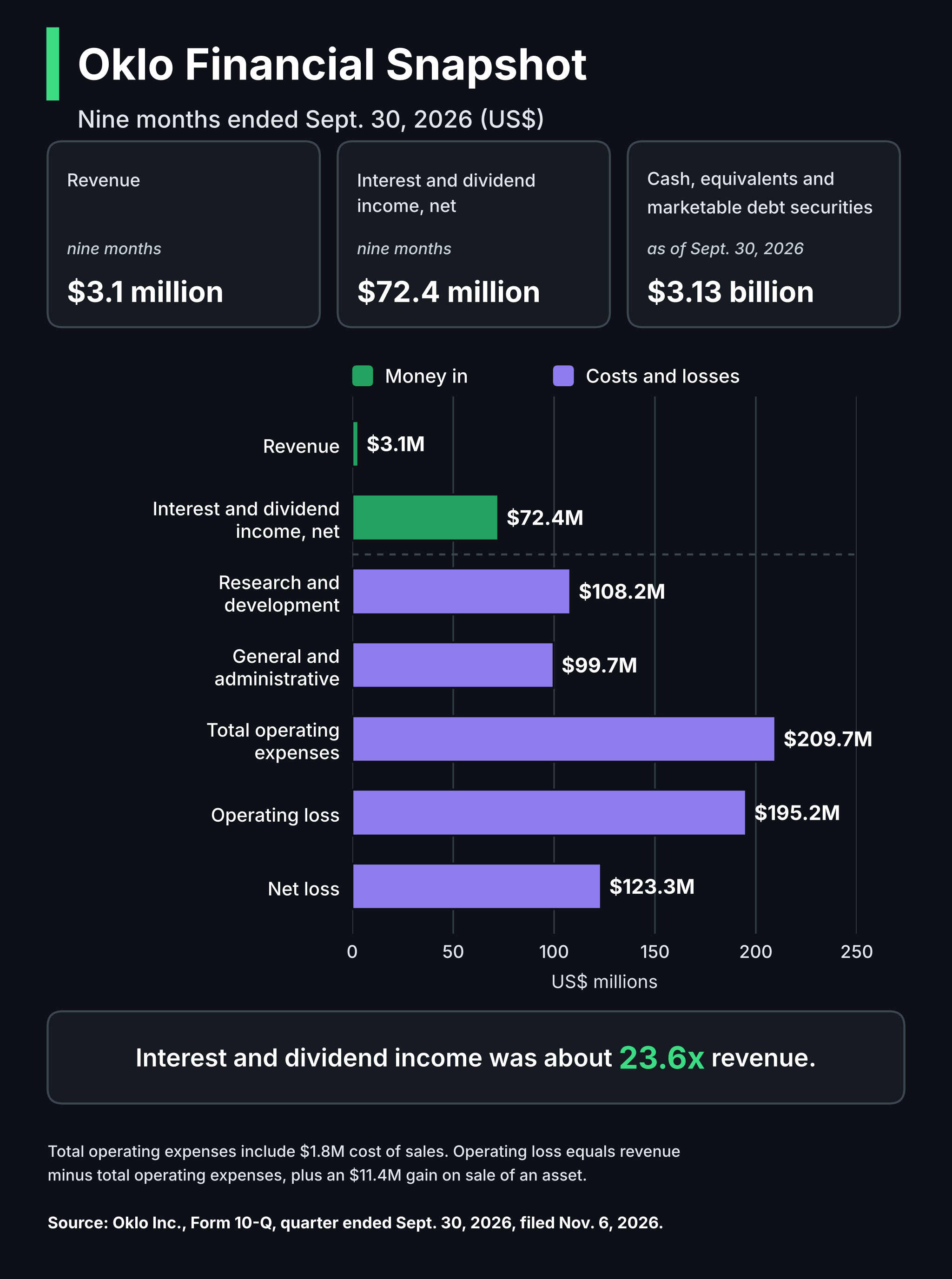
During the first nine months of 2026, Oklo reported just $3.07 million in revenue, primarily from recently acquired engineering businesses, against operating losses of $195 million. Yet the company held about $3.13 billion in cash, cash equivalents, and marketable debt securities after raising $2.25 billion through equity sales during the same period, about 730 times its operating revenue. Perhaps most revealingly, its $72.4 million in net interest and dividend income exceeded its operating-business revenues more than twentyfold.[3]
The Emperor’s Nuclear Renaissance

Oklo’s transformation of a rudimentary reactor into the centrepiece of an extravagant promotional campaign, enthusiastically embraced by media personalities and government officials, raises questions about the American nuclear industry's seriousness.
Meanwhile, China has approximately 40 GW of conventional nuclear capacity under construction and targets 110 GW of nuclear capacity by 2030, which would surpass the US fleet. It is also making substantial progress on two 600 MWe sodium-cooled fast reactors, the same broad class of technology Oklo hopes to commercialize.[22]
China has brought a pebble-bed, high-temperature gas-cooled reactor plant, the technology X-energy hopes to commercialize, into operation, with another eighteen 250 MW thermal modules reportedly under construction. China even has something to offer the thorium bros, having operated a 2 MW thermal experimental thorium molten salt reactor at full power.[22][23]
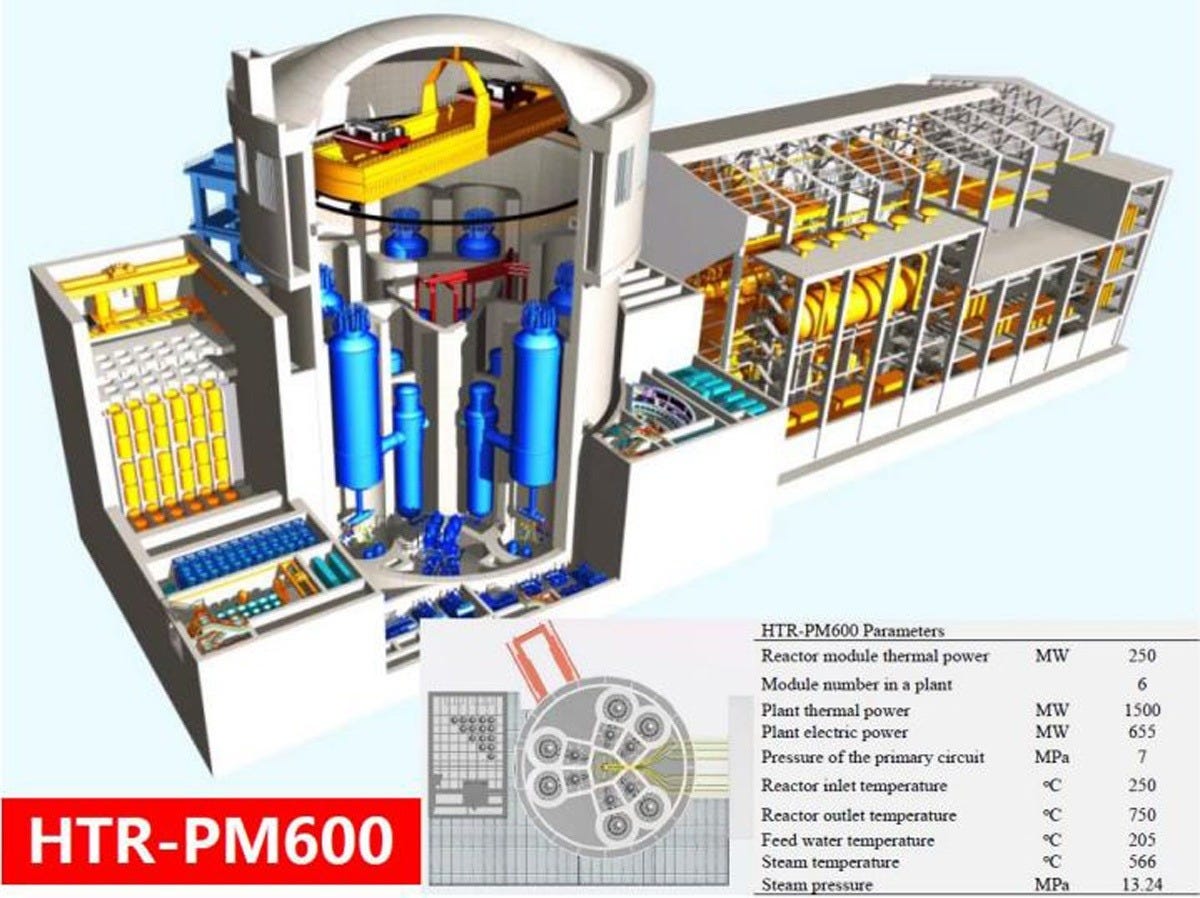
The United States pioneered much of the reactor technology now being developed in China. Today, billions of American dollars flow into speculative ventures, dispersing scarce engineering talent and political attention across programs of uncertain commercial value. An industry once distinguished by extraordinary technical accomplishments now celebrates elaborate simulacra of progress.
The emperor is scantily clad, but the tailors have never been more handsomely paid.
Like this post if you think investors need a light bulb moment.
Support Independent Nuclear Journalism
Decouple’s editorial independence lets us challenge industry orthodoxies, investigate questionable claims, and publish rigorous analysis without seeking permission from the companies or institutions we cover.
Producing this work takes considerable research, and reader support makes it possible. A paid subscription gives you access to our entire archive of interviews, investigations and technical analysis while helping sustain future reporting.
References
[1] Oklo, DOE Startup Authorization for Groves Reactor, July 23, 2026; DOE, Office of Nuclear Energy Celebrates Fifth Advanced Reactor Criticality, August 6, 2026.
[2] The Best One Yet, 1st Pod in a Nuclear Reactor, September 18, 2026; episode transcript.
[3] Oklo, Form 10-Q, nine months ended September 30, 2026, filed November 6, 2026.
[4] DOE, Groves-1 Project NEPA Determination, DOE-ID-26-006, June 2026; NC State, PULSTAR history; PULSTAR reactor specifications.
[5] NuScale, Q3 2026 SEC disclosure, Truedson class action; Pomerantz, class action 26-cv-02483, November 17, 2026.
[6] ANS, The Deadline Arrives: Checking in on the Reactor Pilot Program, July 2, 2026; ANS, Oklo Provides Updates on DOE, NRC Approvals, March 19, 2026; Oklo, Atomic Alchemy Acquisition Completion, March 5, 2025; Oklo, Groves-1 Research and Demonstration Phase, November 11, 2026; POWER, Oklo’s Groves Becomes Fifth DOE Pilot Reactor to Reach Criticality, First on Private Land, August 2026.
[7] Oklo, Groves-2 Forge, DOE Nuclear Energy Launch Pad Selection, October 13, 2026; Oklo, Q3 2026 Company Update, slide 23.
[8] Oklo, Switch 12 GW Master Power Agreement, December 18, 2024; Oklo, Meta 1.2 GW Agreement, January 9, 2026.
[9] Argonne National Laboratory, Assessment of Regulatory Technology Gaps for Advanced Small Modular Sodium Fast Reactors, ANL-SMR-9, May 31, 2014; National Academies, Laying the Foundation for New and Advanced Nuclear Reactors in the United States, 2023; ARPA-E, Electrorefining Facility to Close the Metal Fuel Cycle.
[10] Oklo, Q3 2024 Shareholder Letter, pp. 7, 16; Oklo, Proposed Acquisition of Atomic Alchemy, November 14, 2024; World Nuclear News, China Eyes Expansion of Radioisotope Industry, November 6, 2024; Research Nester, Nuclear Medicine Market Forecast, February 7, 2024.
[11] European Commission, European Radioisotope Valley Initiative (ERVI): Feasibility Study, March 2026, §§2.3.2, 4.1, 4.2.4 and 6.4.1.
[12] Bruce Power, On-Site Hot Cell Facility, July 14, 2026; Bruce Power, CNSC Approval to Operate Hot Cell, August 18, 2026.
[13] CNL, RFP for $370 Million Laboratory Complex, March 19, 2018; AECL, Corporate Plan Summary 2025–26 to 2029–30, p. 17.
[14] Bruce Power, 2022 Annual Review and Energy Report; Bruce Power, 2021 Annual Review.
[15] DOE/NNSA, NorthStar Mo-99 Production Facility, October 3, 2022; AuntMinnie, NorthStar to End Production of Mo-99, October 2023; World Nuclear Association, Radioisotopes in Medicine.
[16] ANSTO, OPAL Multi-Purpose Reactor.
[17] ANSTO, Annual Report 2024–25, Note 1.2A.
[18] YCharts, Oklo Market Capitalization History, November 13, 2026.
[19] Oklo, Q3 2026 Company Update, pp. 9–11.
[20] Ontario Power Generation, 2026 Third Quarter Financial Results, November 10, 2026.
[21] SEC, Oklo Form 4 (Caroline Cochran), filed December 23, 2025; Form 4 (Caroline Cochran), filed January 6, 2026; Form 4 (Jacob DeWitte), filed November 4, 2026.
[22] World Nuclear Association, Nuclear Power in China; China Reactor Database, Xuwei HTR-PM600-1, Xin’an HTR-PM600-1 and Xin’an HTR-PM600-2; VERTIC, Update on CFR-600 Unit 2 at Xiapu, November 12, 2026; IEA, The Path to a New Era for Nuclear Power, January 2025.
[23] World Nuclear Association, Molten Salt Reactors; National Science Review, China’s Progress in Developing Fourth-Generation Nuclear Reactors, November 22, 2025.
Ugh. At least the US has a plethora of gas and an increasing number of ways to turn it into motive power and electricity.